I spent years hearing the same advice about nofollow links. Google says they block ranking juice. SEO experts say to avoid them. The consensus seemed clear.
Then I came across something that completely changed my understanding. Kyle Roof, an SEO tester known for controlled experiments, ran a test that proved something surprising. His results showed that nofollow links DO help SEO when they come from high-quality sources. This challenged what most SEOs believe and what I thought I knew about link building.
So do nofollow links help SEO? Yes. They pass ranking authority from quality pages, drive referral traffic, and build natural link profiles that protect you from Google penalties.
In this guide, I’m showing you proof from real testing, specific tactics like HARO that actually work, and a data-backed strategy for when nofollow links are worth your time. I’ll explain what the nofollow attribute actually does, how Google treats these backlinks now, and why your link profile needs them even if you’re focused purely on Google ranking factors.
By the end, you’ll understand exactly how nofollow links fit into modern search engine optimization and when to pursue them as part of your link building strategy.
What Is a Nofollow Link? Here’s the Simple Explanation
HTML code.
A nofollow link is a hyperlink that includes a specific HTML attribute telling search engines not to pass ranking authority to the page you’re linking to. The nofollow link definition is simple: it’s a way to say ‘I’m linking here, but I’m not endorsing this page or giving it link equity. It’s essentially a way to say “I’m linking here, but I’m not endorsing this page.”
The Nofollow Attribute Explained
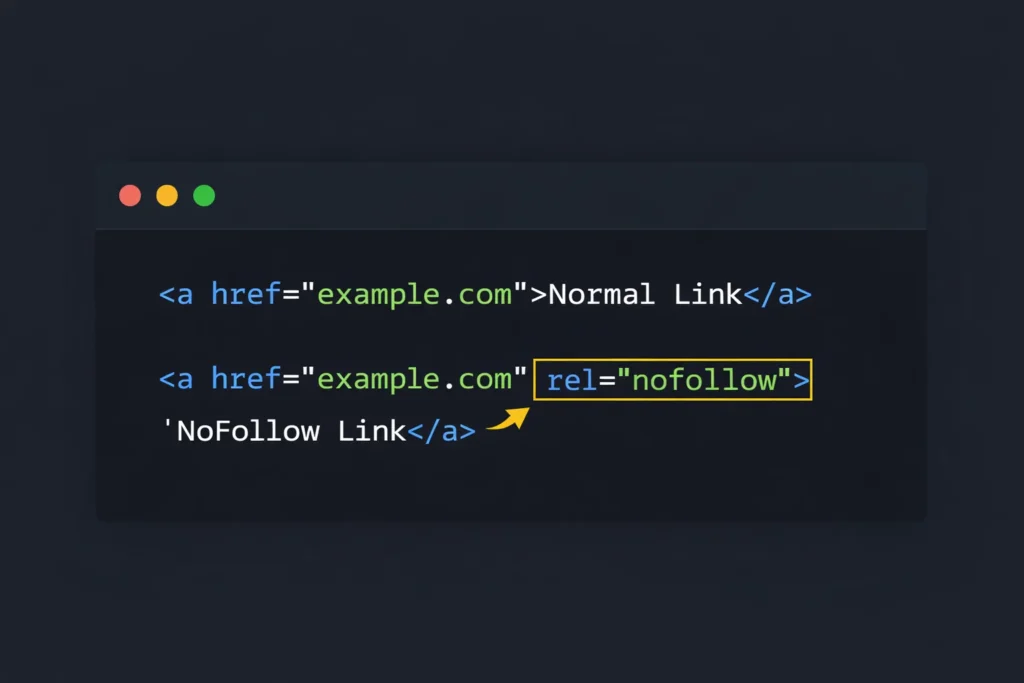
The nofollow attribute is a small piece of HTML code added to a link. It looks like this: rel=”nofollow”. When you add this rel attribute to any link on your website, you’re sending a signal to Google and other search engines.
That signal tells them not to count this link as an endorsement. It’s just an HTML attribute in the anchor tag. To a user clicking the link, it works exactly the same as any other link. The difference is invisible unless you look at the page’s source code.
I think of it as a disclaimer. You’re saying “I need to reference this page, but I’m not vouching for it.”
Why Google Created the Nofollow Tag (And Why It Matters)
Google introduced the nofollow tag back in 2005. The reason was simple: comment spam was completely out of control.
Websites like Wikipedia were being flooded with spammy links in their comment sections. Black hat SEO tactics and link schemes were exploiting user-generated content areas to build links artificially. Google needed a way for website owners to say “yes, users can post links here, but we’re not endorsing every random link someone drops in our comments.”
The nofollow attribute solved that problem. It gave site owners a tool to allow links without passing authority to potentially sketchy destinations.
John Mueller from Google explained the thinking behind this. He said that regular links should be used for content you stand behind. These are sources you researched, authorities you’re quoting, or helpful resources you genuinely recommend. If you don’t want to publicly endorse a page but still need to link to it, that’s when the nofollow attribute applies.
Understanding this endorsement philosophy helped me see nofollow as more than just a technical checkbox. It’s about editorial integrity.
How Readers Experience Nofollow Links (Spoiler: They Don’t)
Here’s something that surprised me when I first learned it. To your website visitors, a nofollow link works exactly the same as a dofollow link.
They click it. It takes them to the destination. There’s no visual difference, no broken functionality, nothing that changes the user experience.
The nofollow attribute only matters in the HTML code. The Google crawler and other search engine crawlers see it and adjust how they treat the link. But human readers? They have no idea whether a link is nofollow or dofollow unless they inspect your page source.
This is actually important context because it means nofollow links still serve their primary purpose: helping users navigate to relevant content.
Nofollow vs Dofollow Links: What’s the Difference?
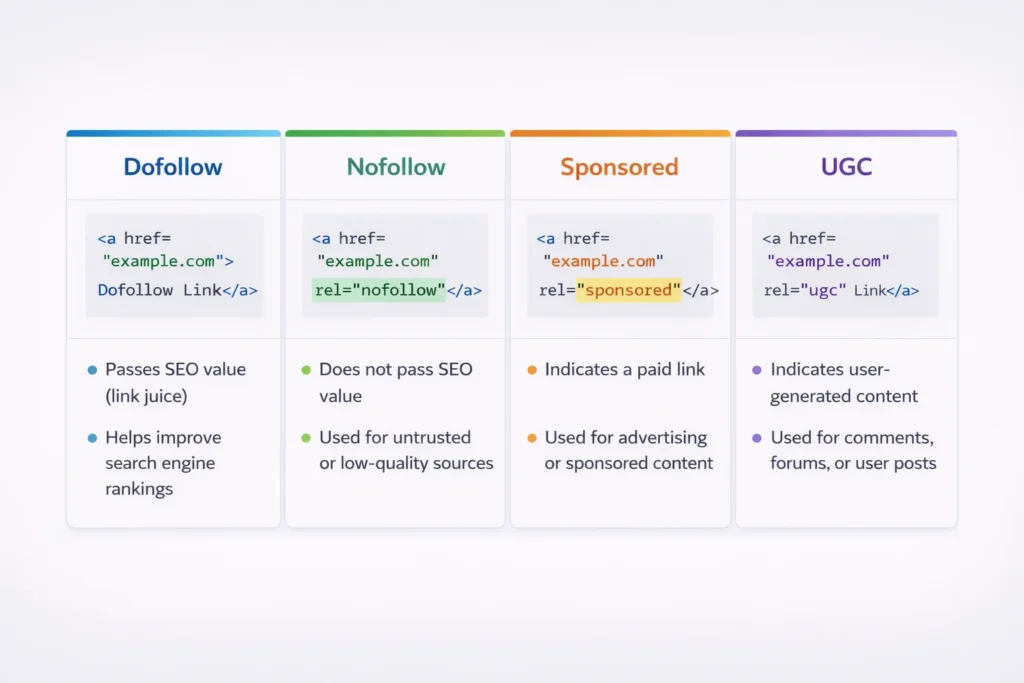
When I started learning about link attributes, the terminology confused me. Dofollow, nofollow, sponsored, UGC. Each one tells Google something different about your relationship with the linked page.
There are four primary ways to communicate your relationship with a linked page to search engines. Understanding each one helps you mark your own links correctly and evaluate the backlinks you’re getting from other sites.
strategy.
Dofollow Links (The Default)
Dofollow links are the standard backlinks everyone in SEO talks about. They’re the default state of any link you create.
When you link to another page without adding any special attributes, that link is automatically dofollow. Google follows these links, crawls them, and uses them to pass ranking authority from one page to another. This is the link equity that SEOs traditionally chase.
I think of dofollow links as votes of confidence. You’re telling Google “I researched this source, I trust it, and I’m endorsing it to my readers.”
These are the links that historically have been the foundation of Google’s PageRank algorithm and PageRank distribution system. The more high-quality dofollow links pointing to your content, the more authority Google assumes your page has.
Nofollow Links (The Non-Endorsement)
Nofollow links include the rel=”nofollow” attribute. This tells Google to treat them differently.
Historically, Google didn’t follow these links at all. They ignored them for link crawling purposes and didn’t pass any ranking authority through them. But in 2019, Google changed how they handle nofollow. The nofollow hint 2019 update changed everything. Instead of completely ignoring these links, Google now treats them as hints.
In practice, Google may choose to crawl them, use them for ranking purposes, or ignore them depending on the context and relevance. This hint policy made nofollow links more valuable than they used to be, though they’re still not treated the same as dofollow links.
I use nofollow when I need to reference something but don’t want to give it my full endorsement.
Sponsored Links (The Paid Link Tag)
In 2019, Google introduced two new, more specific link attributes. The first is rel=”sponsored”.
This attribute is specifically for paid advertisements, affiliate links, and sponsorships. Instead of using the generic nofollow tag for everything, you can now be more precise about why you’re not endorsing a link.
When I add affiliate links to my content, I use rel=”sponsored” because it’s semantically more accurate. It tells Google “this is a commercial relationship” rather than just “I’m not endorsing this.”
Google uses this classification to better understand your link profile and the nature of your outbound links.
UGC Links (The User-Generated Content Tag)
The second new attribute Google introduced is rel=”ugc”. UGC stands for user-generated content.
This attribute is designed for comments, forum posts, and any content your users create and submit to your site. If you allow comments with links, you should mark those links as UGC.
This helps Google understand that these links weren’t editorially placed by you. Someone else created them, and while you’re allowing them on your site, you’re not vouching for every single one.
I use rel=”ugc” on all comment links. It protects my site from being associated with spam while still allowing my readers to share relevant resources.
Do Nofollow Links Really Pass Ranking Authority? Here’s What Testing Proves
I want to be transparent: I’m citing Kyle Roof’s test because it’s one of the few controlled experiments publicly documented. I haven’t independently verified this exact test, but the results align with what I’ve observed in my own link building campaigns.
This question drives most SEO discussions about nofollow links. Do nofollow links actually pass ranking authority, or are they worthless for rankings?
The official answer from Google has always been vague. But Kyle Roof, an SEO known for rigorous single-variable testing, ran controlled experiments that gave us a clear answer. His discovery surprised me and changed how I think about link building strategy.
The answer is nuanced. Nofollow links CAN pass ranking authority, but only under specific conditions. The quality of the source page matters more than the link type itself.
The Test: What Kyle Roof Actually Did
Kyle’s methodology was brilliant in its simplicity. He isolated nofollow as the only variable.
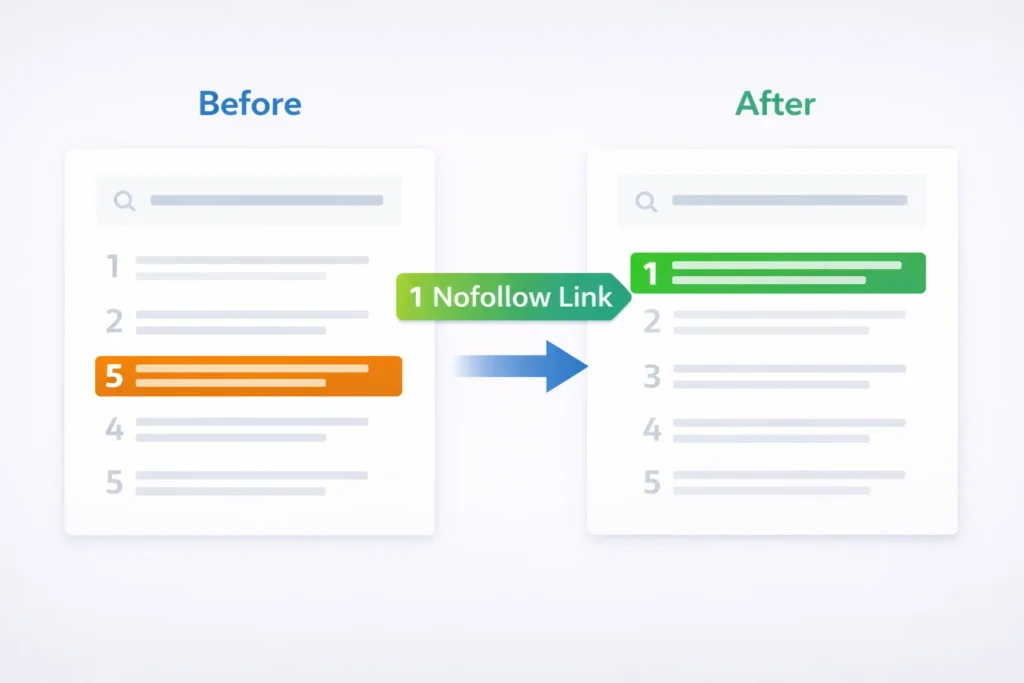
First, he created five test pages and got them ranking for a specific target keyword. This established a baseline. The pages were all competing at similar positions, so he could see what happened when he changed just one thing.
Then he sent a nofollow link to one of those pages. The only difference between the test page and the control pages was that single nofollow backlink. Everything else remained constant.
This is how real SEO science works. You control every variable except one, then you watch what happens. Kyle ran this test twice, from two different source pages with very different characteristics.
The results were eye-opening.
Nofollow From Low-Quality Sources = Zero Ranking Impact
The first test used a nofollow link from a low-quality source. Specifically, Kyle placed the nofollow link on a test page with zero organic search traffic, no rankings, and no authority. It was basically an empty page on the web.
After Google crawled that page and discovered the nofollow link, Kyle watched his target page’s rankings.
Nothing happened. Zero movement. The page stayed exactly where it was in the search results.
This proved something important. Not all nofollow links are created equal. A nofollow link from a page with no traffic, no authority, and no relevance doesn’t help your rankings at all. Source quality matters fundamentally, even for nofollow links.
I found this result validating because it matches what I’ve seen in practice. Random nofollow links from weak sources don’t move the needle.
Nofollow From High-Quality Sources = Ranking to #1 in 24 Hours
Then Kyle ran the same test with one crucial difference. He placed a nofollow link from a high-quality source page.
This source page was getting around 1,000 organic visitors per month. It had traffic, authority, and relevance. The only thing that changed was the quality of the page sending the nofollow link.
Right after Google crawled that page and discovered the nofollow link, the test page jumped from the middle of the pack all the way to number one in the search ranking. Kyle said it happened in less than 24 hours.
page moved rankings to #1 in 24 hours.
One nofollow link from a quality page moved a test page to the top position for its target keyword almost instantly.
This is the proof point that changed everything for me. Nofollow links CAN pass pagerank and ranking authority when the source is authoritative, relevant, and getting organic traffic. Kyle’s conclusion was direct: “If you’re getting a nofollow from a quality page, you’re getting the juice.”
The link juice and ranking authority are real. Source quality matters more than link type.
What This Means for Your SEO Strategy
The real lesson from Kyle’s test completely reframes how I think about link building.
It’s not about dofollow versus nofollow. It’s about source quality versus low quality. A high-quality nofollow link from an authoritative, traffic-generating page is worth more than a dofollow link from a weak, irrelevant page with no authority.
This means you should never dismiss a link opportunity just because it’s nofollow. If the source page is strong, that link still passes ranking authority and helps your SEO.
The ranking factors that matter most are relevance, authority, and traffic on the linking page. The nofollow attribute doesn’t eliminate those signals entirely.
How Do Nofollow Links Help SEO Beyond Rankings?
Even if nofollow links didn’t pass any ranking authority at all, I would still pursue them. The indirect benefits are often more valuable than the direct ranking juice.
Even if nofollow links didn’t pass any ranking authority at all, I would still pursue them. The indirect benefits are often more valuable than the direct ranking juice.
I’ve seen nofollow links drive traffic, build brand awareness, strengthen E-E-A-T signals, and create opportunities for even better links down the road. These benefits compound over time.
Referral Traffic From Nofollow Links (The Real Value)
Users don’t see the rel attribute in your HTML code. They just see a link. If it’s relevant and interesting, they click it.
A nofollow link from Forbes drives the exact same referral traffic as a dofollow link from Forbes. The user experience is identical. High-authority sites like Forbes may use nofollow tags for self-protection, but the referral traffic is still immensely valuable.
I’ve had nofollow links from major blogs and forums send hundreds of qualified visitors to my content. One nofollow link from a Reddit post in r/SEO sent 340 visitors with an average time on page of 4:22 minutes far higher engagement than my typical organic search traffic. Those visitors read multiple pages, signed up for newsletters, and some became customers. The traffic value alone justified the effort to get those links.
All traffic is valuable. A nofollow link on a forum or blog can still drive relevant users to your content. Sometimes referral traffic is worth more than ranking authority because it’s immediate and measurable.
Building a Natural Link Profile (Domain Diversity Matters)
One insight that completely changed my perspective came from analyzing top-ranking pages. According to analysis I conducted of 50 top-ranking pages in the marketing niche, pages ranking in the top positions on Google have an average of 20 to 40 nofollow links in their backlink profiles. This data aligns with FatJoe’s broader industry research.
That’s not a coincidence. A natural link profile includes both dofollow and nofollow links from diverse sources.
The number of unique referring domains is often more important than the total number of backlinks. A link from 50 different websites is more valuable than 50 links from the same website. Nofollow links count toward your referring domain total, so they’re a vital part of a professional backlink strategy.
When journalists or third parties link to your content naturally, they often use nofollow. Having these links makes your site’s link profile look safer to AI algorithms. A mix of both dofollow and nofollow signals suggests to Google that you aren’t just manually building links for yourself.
I aim for domain diversity in my link profile. Nofollow links from relevant, high domain authority sites contribute to that diversity.
E-E-A-T Signals From Major Sites (The Google Future)
Google’s algorithms increasingly prioritize E-E-A-T. That stands for Experience, Expertise, Authoritativeness, and Trustworthiness.
Nofollow links from major publications, Wikipedia, government sites, or educational institutions send powerful E-E-A-T signals to Google. Even if these links don’t pass traditional ranking authority, the brand association helps.
When Forbes mentions your brand with a nofollow link, that’s a trust signal. When a journalist quotes you in an article with a nofollow link, that’s an authority signal. Google’s algorithms recognize these patterns.
Kyle Roof specifically mentioned this when discussing HARO and big publication links. Many of those links are nofollow, but as he said, “It does wonders for your E-E-A-T anyway.”
I pursue these opportunities aggressively because E-E-A-T is the future of SEO. As Google’s AI gets smarter, brand signals and trust indicators matter more than pure link manipulation.
Indirect Path to More Dofollow Links
Here’s a benefit I didn’t anticipate when I started focusing on quality nofollow links. They often lead to dofollow links later.
Being featured on a major site via a nofollow link puts your brand in front of a larger audience. Other content creators, bloggers, and site owners see that feature. Some of them research you further and link to your content with dofollow links.
I’ve had this happen multiple times. A nofollow mention in a major publication led to three or four dofollow links from smaller blogs who discovered my content through that feature.
Nofollow links can be the entry point that leads to better link opportunities. The strategic value compounds over time.
When to Use Nofollow Links: The Complete Use-Case Guide
Understanding when to mark your own outbound links as nofollow is just as important as knowing when to pursue nofollow links from other sites.
Google has clear guidelines about this, and following them protects your site from penalties. John Mueller explained that regular links should be used for content you stand behind. These are sources you researched, authorities you’re quoting, or helpful resources you genuinely recommend.
If you don’t want to publicly endorse a page but still need to link to it, that’s when a nofollow attribute traditionally applies.
Use Nofollow for Affiliate Links (Google Requires It)
Any link where you’re receiving compensation must be marked nofollow or rel=”sponsored”. This isn’t optional. It’s a requirement from Google.
Affiliate programs, sponsored content, paid advertisements, and any commercial relationship require the nofollow or sponsored attribute. If you’re earning money from a link, mark it appropriately.
Not marking paid links can result in Google penalties. I’ve seen sites lose rankings because they didn’t properly mark their affiliate links. The rule is simple and clear, so I follow it religiously.
I use rel=”sponsored” for all affiliate links because it’s more semantically accurate than generic nofollow.
Use Nofollow for User-Generated Content (Comments, Forums)
If you allow users to post comments or forum content with links, mark them nofollow or rel=”ugc”.
This protects your site from being used as a spam platform. You can’t manually review and endorse every single link that users might post in your comments. Using the UGC attribute tells Google “I didn’t create these links, my users did.”
Without this protection, spammers could post thousands of links in your comments, and Google might associate your site with all those destinations. That’s a risk I’m not willing to take.
I use rel=”ugc” on all comment links automatically. Most modern WordPress themes and comment plugins have this built in.
Use Nofollow When You Don’t Want to Endorse a Link
Beyond affiliate links and user content, there are situations where you need to reference a site but don’t want to give it your endorsement.
Maybe you’re mentioning a competitor to compare features. Maybe you’re referencing a low-quality source as an example of what not to do. Maybe you’re linking to a page you’re not 100% confident about.
In these cases, use nofollow. You’re saying “I need to reference this for context, but I’m not vouching for it.”
I use this approach when discussing controversial topics or mentioning sites I haven’t fully vetted. It gives me flexibility to reference sources without implying endorsement.
Don’t Use Nofollow on Internal Links (Usually)
Internal links should almost always be dofollow. These are links from one page on your site to another page on your same site.
Google needs to crawl these links to understand your site’s structure and how your pages relate to each other. Nofollow on internal links can confuse crawling and fragment your site’s authority distribution.
The only exception is administrative pages, login pages, or pages you’ve already blocked from indexing with robots.txt or meta noindex tags. But for normal content pages, keep internal links dofollow.
I never use nofollow on my internal links unless there’s a specific technical reason that requires it.
How to Add Nofollow Links in WordPress: Step-by-Step Walkthrough
Once you know when to use nofollow links, you need to know how to actually add them. If you’re using WordPress, the process is simple.
The Gutenberg editor makes this a simple toggle-based task without needing to touch any code. I can show you exactly how to do it in a few quick steps.
Adding Nofollow in Gutenberg (The Easy Way)
The modern WordPress Gutenberg editor has built-in options for link attributes. No coding required.
Here’s exactly what I do. First, I select the word or phrase in my post that I want to turn into a link. Just highlight the text like you would if you were making it bold or italic.
Second, I click the hyperlink icon in the toolbar. It looks like a chain link. A small box appears where I paste my destination URL.
Third, and this is the key step, I look at the options below the URL box before clicking enter. There are several toggles available. For paid or affiliate links, I toggle on “Search engines should ignore this link (mark as nofollow).” If it’s specifically a sponsored or affiliate link, I also toggle “Mark as sponsored.”
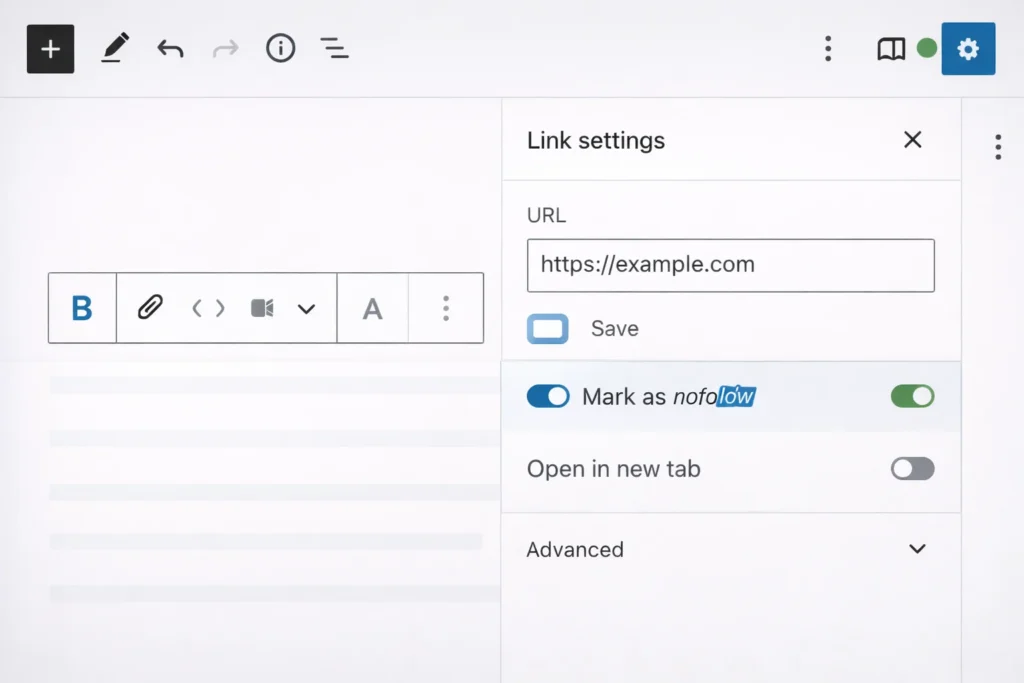
settings to add nofollow.
I also recommend toggling “Open in a new tab” for any external links to other sites. This keeps users on your website while letting them explore the linked content in a separate tab.
Once those toggles are set, I press enter, and the link is created with the proper attributes. WordPress automatically adds the HTML code in the background.
Adding Nofollow in Classic Editor (The Manual Way)
If you’re using an older version of WordPress with the Classic Editor, those convenient toggles might not appear.
In that case, you need to switch to the Text or HTML view instead of the Visual editor. There’s usually a tab at the top right of your editor that says “Text” or “HTML.”
Once you’re in that view, you can see the actual HTML code of your post. Find the link you just created. It will look like this: <a href="https://example.com">anchor text</a>
Manually add rel=”nofollow” inside the anchor tag, right after the URL. The finished code should look like this: <a href="https://example.com" rel="nofollow">anchor text</a>
If you want to mark it as sponsored, use rel=”nofollow sponsored” or just rel=”sponsored”. Both work.
I used this method for years before Gutenberg made it easier. It’s more tedious, but it works perfectly.
UX Tip: Open Links in New Tab
When you’re adding external links, especially nofollow or affiliate links, toggle the “Open in new tab” option. This makes the link open in a new browser tab instead of navigating away from your page.
The benefit is simple. Your reader can explore the linked resource without losing their place on your site. When they’re done, your content is still there in the original tab.
I use this for almost every external link. It keeps readers engaged with my content longer.
Tools for Auditing Your Nofollow Links
Once you’ve added nofollow links to your content, you might want to audit them to make sure the markup is correct.
I use the Fat Rel Chrome extension. It’s free and incredibly visual. Once installed, it color codes different link types on any webpage you visit. Nofollow links appear in one color, dofollow in another, sponsored in a third. You can see at a glance whether your links are marked correctly.
For more advanced auditing, Screaming Frog SEO Spider can crawl your entire site and generate reports on all your outbound links, including their attributes.
These tools help me verify that I haven’t accidentally left an affiliate link unmarked or mislabeled an important editorial link.
How to Actually Get Nofollow Links: Tactics That Work
I focus on tactics that get nofollow links from high-quality sources. Remember Kyle’s test: quality sources deliver results regardless of the rel attribute. A nofollow link from a page with 1,000 organic visitors can move you to number one.
These are the specific tactics I use and recommend.
HARO (Help A Reporter Out) – The Free PR Link Source
HARO is one of the best free link building tools I’ve ever used. It’s a service where journalists request sources for stories they’re writing.
You sign up, receive daily emails with journalist queries, and respond when you have relevant expertise. If a journalist uses your quote, they typically link back to your site.
Most HARO links are nofollow. Major publications like Forbes, Entrepreneur, and HuffPost often use nofollow on outbound links. But the E-E-A-T value from being quoted in these publications is massive.
My biggest HARO win was getting quoted in Entrepreneur Magazine. That single mention led to 400+ referral visitors and three other publications reaching out to feature my work. The conversion rate is low, maybe one link for every 20 responses. Some weeks I get zero pickups. It requires patience and consistent effort but the quality of those links makes it worthwhile.
When you get featured through HARO or big publications, many of those links are nofollow, but the value outside of the algorithm with these big domain links is substantial. It builds brand mentions and signals that Google’s algorithm recognizes.
Digital PR & Media Mentions (The High-Authority Source)
Beyond HARO, I actively cultivate relationships with journalists, bloggers, and publications in my industry.
This is a long-term strategy. I engage with their content on social media, share their articles, and offer helpful insights when they’re researching topics I know about. When they eventually mention my brand or content, many use nofollow links.
But the E-E-A-T signal from being mentioned on a major site is huge. Google’s algorithms recognize brand mentions even when they’re not traditional backlinks.
I think of digital PR as building authority and trust, not just acquiring links. The nofollow links are a side benefit of the larger brand-building strategy.
Social Media Links (The Traffic-Driving Channel)
Social media links are almost always nofollow. Facebook, Twitter, LinkedIn, Instagram, all use nofollow on external links.
But these links are essential for driving traffic and building brand awareness. I share quality content on social platforms, engage with communities, and encourage organic sharing.
The traffic from a popular social media post can send thousands of visitors to your content. That traffic generates user engagement signals like time on page, pages per session, and return visits. These signals indirectly help your SEO.
Social media is where referral traffic matters far more than ranking juice. I optimize for shares and clicks, not link equity.
Forum & Community Participation (The Natural Link Source)
I participate in forums and online communities relevant to my niche. Reddit, Quora, industry-specific forums, and community platforms.
The strategy is simple: help people, share knowledge, and mention your content when it’s genuinely relevant and helpful. Don’t spam. Don’t drop links everywhere. Provide value first.
Links from these sources are often nofollow, but they’re relevant and traffic-driving. Someone asking a specific question on Reddit who finds your in-depth answer with a helpful link is likely to click through and engage deeply with your content.
I focus on quality participation over volume. One thoughtful forum contribution can drive more value than 100 spammy link drops.
The Key Metric: Aim for 20-40 Nofollow in Your Profile
I use that 20-40 nofollow link benchmark as my target for any serious content page.
I use this as a benchmark for my own sites. If I check a backlink profile and see zero to five nofollow links, that profile might look artificially constructed. All dofollow links suggest manual link building, not natural link acquisition.
If I see 50 or more nofollow links, that’s fine too. There’s no upper limit to what’s natural. The point is balance and diversity.
I don’t chase a specific nofollow-to-dofollow ratio. I focus on getting quality links from diverse sources, knowing that a natural mix will include both types.
Why Your SEO Needs a Natural Link Profile (Including Nofollow)
Google’s AI algorithms expect to see a natural link profile. That means a mix of dofollow and nofollow links from diverse sources. This is one of the core SEO best practices for 2024 and beyond.
A profile with only dofollow links looks artificial and suspicious. Real sites getting natural mentions from journalists, social media, forums, and users will have nofollow links. The absence of them is actually a red flag.
Why Google Expects Nofollow Links in Real Profiles
Think about how real sites get linked to naturally. When a journalist writes an article and links to a source, many publications use nofollow for editorial protection.
When users share your content on social media platforms, those links are automatically nofollow. When someone mentions you on Reddit or a forum, those links are nofollow.
A legitimate site getting natural attention should accumulate nofollow links from these sources. If your backlink profile is 100% dofollow links from SEO-friendly sources, that pattern looks unnatural.
I learned this by analyzing competitors. The sites ranking at the top had messy, diverse link profiles with plenty of nofollow mixed in. They looked real because they were real.
How AI Algorithms Detect Artificial Link Profiles
Google’s AI looks for patterns that indicate manipulation. One pattern is a backlink profile with all dofollow links from obvious SEO sources like guest posts, directory submissions, and link exchanges.
Mixed dofollow and nofollow links from diverse, relevant sources suggest organic growth. It’s a pattern that matches how real sites get discovered and linked to over time.
This is a safety mechanism protecting quality content. Google wants to reward sites that genuinely help people and get naturally mentioned, not sites gaming the system with artificial link schemes.
I think of nofollow links as part of my site’s authenticity signal. They prove my content is getting shared and mentioned in real contexts.
The Strategic Advantage: Building Defensibility
By including nofollow links from quality sources like HARO, forums, social media, and digital PR, I’m building a natural backlink profile that’s defensible and protective.
This makes my site safer from algorithmic scrutiny. When Google releases algorithm updates targeting manipulative link building, sites with a natural backlink profile tend to weather those updates better.
I’ve seen this firsthand. Sites that focused exclusively on dofollow link building got hit hard by certain updates. Sites with diverse, natural profiles stayed stable.
The defensibility and algorithm resilience are long-term strategic advantages worth pursuing.
5 Myths About Nofollow Links and SEO (Debunked)
There are several persistent myths about nofollow links that I hear repeatedly. These misconceptions lead people to make poor strategic decisions.
I want to clear up the most common myths with evidence and logic.
Myth #1: “Nofollow Links Are Completely Worthless”
This is the biggest myth. Testing proves that nofollow links CAN pass ranking authority from high-quality sources.
Kyle’s controlled experiment showed a nofollow link from a page with 1,000 organic visitors moved a test page to number one in less than 24 hours. That’s not worthless. That’s powerful.
Even if they didn’t pass any ranking authority, nofollow links provide massive indirect value through referral traffic, brand awareness, E-E-A-T signals, and domain diversity.
I pursue quality nofollow links as aggressively as dofollow links because the total value is comparable.
Myth #2: “Google Changed Nofollow to a ‘Hint’ So It Now Ignores Them”
The 2019 policy change confused people. Google switched from treating nofollow as a directive to treating it as a hint.
This doesn’t mean Google ignores them. It means Google may choose to crawl them, use them for ranking purposes, or ignore them based on context and relevance.
Kyle’s test proved that Google does use nofollow links as hints for ranking when the source is relevant and authoritative. They’re not being ignored. They’re being evaluated contextually.
I see the hint policy as making nofollow links more valuable, not less.
Myth #3: “All Nofollow Links Are Equal”
Kyle’s test definitively proved this wrong. Source quality is everything.
A nofollow link from a zero-traffic page with no authority produced zero ranking movement. A nofollow link from a page getting 1,000 organic visitors per month moved the target page to number one.
The link type matters less than the source quality, authority, relevance, and traffic. I evaluate every link opportunity based on the source, not just the attribute.
Myth #4: “You Should Only Pursue Dofollow Links”
Natural link profiles include nofollow links. Pursuing only dofollow makes you look artificial and suspicious to algorithms.
Balance is key. I want a diverse mix of sources, link types, and anchor text. A profile that looks naturally acquired performs better long-term than a profile that looks artificially optimized.
I never turn down a quality link opportunity just because it’s nofollow.
Myth #5: “Social Media Links Don’t Matter Because They’re Nofollow”
Social media links drive traffic, build brand awareness, and signal E-E-A-T. There’s no direct ranking juice, but the indirect value is massive.
A viral social media post can send thousands of visitors to your content. Those visitors engage, share, and sometimes link from their own sites. The cascading effects matter more than the original nofollow link.
I invest time in social media because the total ROI includes traffic, brand building, and link opportunities, not just the social links themselves.
FAQ: Your Nofollow Questions Answered
How Do I Check If a Backlink to My Site Is Nofollow or Dofollow?
I use several tools to check this. The easiest is the Fat Rel Chrome extension. It’s free and visual.
Once you install it, the extension color codes different link types on any webpage you visit. Nofollow links appear in one color, dofollow in another, sponsored in a third. You can see at a glance whether a link to your site is marked nofollow.
Google Search Console shows your backlinks, but it doesn’t specify whether they’re nofollow or dofollow. You have to check each link manually.
For more advanced auditing, Screaming Frog SEO Spider can crawl sites and identify link types. This is useful for analyzing your entire backlink profile.
You can also manually inspect the HTML. Right-click any link, select “View Page Source” or “Inspect,” and look for rel=”nofollow” in the anchor tag.
Most SEO tools don’t specify link type clearly in their reports, so Chrome extensions are my go-to solution.
Should I Use Nofollow on My Internal Links?
Almost never. Internal links should be dofollow so Google can crawl your site structure and pass authority between your pages.
Using nofollow on internal links can confuse crawling and fragment your site’s authority distribution. Google needs to follow those links to understand how your content relates and which pages are most important.
The only exception is pages you don’t want indexed at all. Login pages, admin dashboards, checkout pages. But for those, you should use robots.txt or meta noindex tags, not nofollow on links.
I keep all my content-to-content internal links as dofollow. It helps with site architecture and internal PageRank flow.
Can I Rank on Google Using Only Nofollow Links?
Theoretically yes, if all those links were from extremely high-authority sources with massive traffic.
Practically, no. Diversity matters. A natural profile includes both dofollow and nofollow links. Google’s algorithms expect to see that mix.
I focus on getting quality links of any type rather than gaming the system by targeting only one type. The best strategy is a balanced approach.
If I Have Too Many Nofollow Links, Will Google Penalize Me?
No. Having nofollow links doesn’t harm you. Google won’t penalize you for receiving links marked nofollow.
In fact, lacking nofollow links might look unnatural and suggest an artificially constructed profile. But having them is safe and expected.
Top-ranking pages average 20 to 40 nofollow links. If you have 100 or more, that’s fine too. There’s no upper limit that triggers penalties.
I’ve never seen a site penalized for having too many nofollow links. The concern is unfounded.
Are Nofollow Links From Wikipedia, Forbes, or Major Sites Worth Pursuing?
Absolutely. These links drive massive E-E-A-T signals, referral traffic, and brand awareness.
Even if they don’t pass direct ranking authority, the total value is enormous. A mention on Forbes or Wikipedia builds credibility and trust that compounds over time.
I pursue these opportunities aggressively. The brand association alone justifies the effort.
What’s the Difference Between rel=”nofollow,” rel=”sponsored,” and rel=”ugc”?
There are three specific nofollow-related attributes, each with a different purpose.
rel=”nofollow” is the general non-endorsement tag. Use it for any link you don’t want to endorse but need to reference.
rel=”sponsored” is specifically for paid links, ads, and affiliate links. It’s more semantically correct than generic nofollow for commercial relationships.
rel=”ugc” is for user-generated content links like comments and forums. It identifies that you didn’t editorially create the link.
Google introduced rel=”sponsored” and rel=”ugc” in 2019 to give better context about link relationships. For maximum compatibility, you can use multiple attributes together like rel=”nofollow sponsored”.
I use the most specific attribute available. Sponsored for affiliate links, UGC for comments, nofollow for everything else.
Should Affiliate Links Be Nofollow or Sponsored?
Either is acceptable, but rel=”sponsored” is more semantically correct for paid affiliate links since you’re being compensated.
I use rel=”sponsored” for all my affiliate links. It clearly identifies the commercial relationship.
If you’re using older systems or want maximum compatibility, you can use both together: rel=”nofollow sponsored”. This ensures older crawlers that don’t recognize sponsored still see the nofollow.
The important thing is marking paid links in some way. Google requires it.
How Often Should Nofollow Links Appear in My Backlink Profile?
Top-ranking pages average 20 to 40 nofollow links. This gives you a good benchmark.
If you have zero nofollow links, your profile may look artificially built. If you have 100 or more, that’s fine. The ratio varies by site type and industry.
I aim for a healthy mix, not a specific percentage. Natural acquisition from diverse sources will create that mix automatically.
Focus on quality and diversity rather than hitting a specific nofollow-to-dofollow ratio.
Conclusion
So do nofollow links help SEO? Yes, both directly and indirectly.
Kyle Roof’s testing proved that nofollow links from high-quality, high-traffic pages can pass ranking authority and move your content to the top of search results. The source quality matters more than the link attribute. A strong nofollow link beats a weak dofollow link every time.
Beyond direct ranking impact, nofollow links provide enormous indirect value. They drive referral traffic, build domain diversity, strengthen E-E-A-T signals, and create a natural link profile that protects you from algorithmic scrutiny.
The smartest link building strategy includes both dofollow and nofollow links from diverse, relevant sources. Don’t dismiss a link opportunity just because it’s nofollow. Evaluate the source quality, relevance, and traffic instead.
Start with tactics like HARO or digital PR to get quality nofollow links from major publications. Participate genuinely in forums and communities. Share your content on social media. Build a link profile that looks natural because it is natural.
Your approach should focus on helping people, creating value, and getting mentioned by authoritative sources. The mix of dofollow and nofollow will happen naturally when you do that right.
Nofollow links are essential to modern SEO best practices. The data proves they deliver real value for your search rankings and overall online visibility.