

The Simple Answer: How Many SEO Keywords Should I Use?
When people ask me how many SEO keywords should I use, I recommend one primary keyword and enough secondary keywords to thoroughly explain your topic. After optimizing hundreds of pages for search engine optimization, I’ve found this approach works far better than trying to stuff multiple primary keywords into a single piece of content.
My magic number is simple: one primary keyword plus 3-7 secondary keywords that naturally support your main topic. This gives you enough variety to rank for multiple search terms without confusing Google about your page’s main focus.
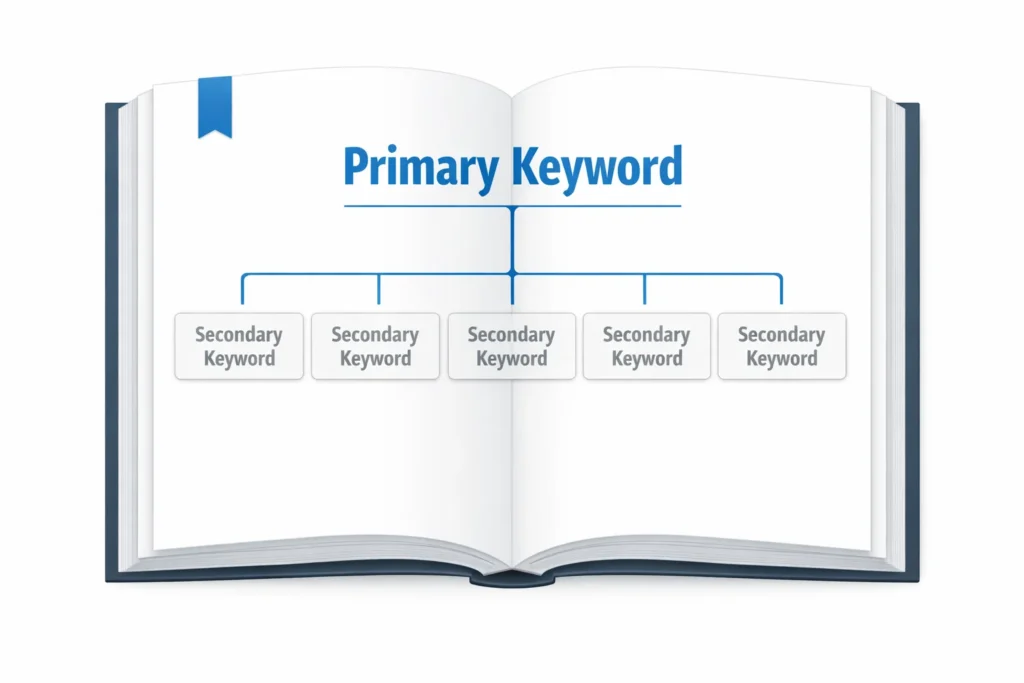
Think of it like writing a book chapter. Your primary keyword is the chapter title, and your secondary keywords are the different points you make within that chapter. When I structure content this way and properly add SEO keywords to your content, I consistently see better rankings and more organic traffic.
Most SEO experts agree that trying to target multiple primary keywords on one page creates keyword cannibalization. I’ve seen this happen countless times where pages compete against each other instead of helping each other rank higher.
Google’s algorithm has evolved dramatically over the years. Google can now rank a single page for hundreds of semantically related keywords if you write comprehensive, helpful content around one main topic through focused content optimization.
I use what I call the “Rule of Five” for my primary keyword. I include my main keyword about five times throughout the entire post. This usually works out to roughly once every 200-300 words in longer articles.
What Are Primary vs Secondary Keywords (And Why It Matters)
Primary keywords are your content’s main focus, while secondary keywords add context and depth to help Google understand your topic better. I always explain this concept to my clients using a simple book analogy.
Your primary keyword is like the title of a book chapter. It tells readers and search engines exactly what your content is about. Secondary keywords are like the different sections within that chapter that explore various angles of your main topic.
Primary Keywords: Your Content’s Main Focus
Primary keywords represent the main search query you want to rank for. These target keywords and focus keywords typically have higher search volume and more competition than their supporting keywords.
Through an organized SEO audit process and keyword research, I choose primary keywords based on three factors: search volume, keyword difficulty, and relevance to my target audience. My goal is finding that sweet spot where you have enough search demand to drive traffic but not so much competition that you can’t rank.
When I analyze successful pages, I notice they always have one clear primary keyword that appears in the title, main heading, and naturally throughout the content. This clarity helps search engines understand exactly what the page offers.
Secondary Keywords: The Supporting Cast
Secondary keywords are keyword variations and long tail keywords that flesh out your main topic. I think of these as the supporting cast that makes your primary keyword shine brighter.
These supporting terms help you cover every relevant angle of your topic without diluting your main focus. When I use secondary keywords effectively, I can rank for dozens of related search queries from a single piece of content.
The best secondary keywords often include modifiers, question words, and related terms that people search for when they want to learn about your primary keyword. I find these by analyzing what questions my audience actually asks about the topic.
Why One Primary Keyword Per Page Actually Works Better
Google’s semantic search capabilities mean you don’t need to target multiple primary keywords on one page anymore. This focused content optimization approach typically generates more organic traffic than scattered keyword targeting.
I’ve tested both approaches extensively. Pages targeting one primary keyword consistently outrank pages trying to target multiple primary keywords. The reason is simple: focused content provides more value to searchers.
Search engine bots scan headers first to establish content priority. When you have multiple competing keywords in your headings, bots struggle to determine your page’s main purpose. This confusion typically leads to lower rankings across all your target keywords because it violates core ranking factors that Google evaluates.
How Google’s Semantic Search Changes Everything
Google’s natural language processing understands context and keyword variations better than ever before. This capability isn’t unique to Google. Google and other search engines now analyze the meaning behind search queries to deliver better results. This means when I write about “digital marketing,” Google knows I’m also relevant for searches about “online marketing,” “internet marketing,” and “web marketing.
Semantic search analyzes the meaning behind search queries rather than just matching exact keywords. I’ve found that writing naturally about a topic often captures more search traffic than trying to optimize for every possible keyword variation.
What I’ve learned from years of testing is that comprehensive coverage of one topic beats shallow coverage of multiple topics. When I focus all my content energy on thoroughly explaining one primary concept, Google recognizes my page as an authority on that subject.
Building topical authority requires deep focus rather than broad keyword targeting. I’ve seen pages improve their SERP rankings by becoming the go-to resource for one specific topic instead of trying to rank for everything.
Content quality becomes one of the most important ranking factors when you concentrate your expertise on a single primary keyword. I can provide more examples, answer more questions, and offer more value when I’m not spreading my attention across multiple main topics.
I also find this approach makes my content planning much simpler. Instead of wondering which keywords to include, I ask myself what information would help someone understand my primary keyword completely.
Why Keyword Stuffing Kills Your Rankings (And How to Avoid It)
Keyword stuffing degrades the reading experience, leading to higher bounce rates and lower rankings. I’ve seen well-intentioned content creators destroy their SEO results by forcing keywords into every sentence.
The biggest mistake I see is forcing the same keyword multiple times in a single paragraph, which can trigger a keyword stuffing penalty. This practice immediately signals over-optimization to search engines and creates a poor reading experience for users. Avoiding this mistake is essential for ranking improvement.
Over-optimization creates a domino effect that hurts multiple ranking factors. When your content reads unnaturally, visitors leave quickly. High bounce rates signal to Google that your page doesn’t satisfy search intent, which damages your rankings.
What Keyword Stuffing Actually Looks Like
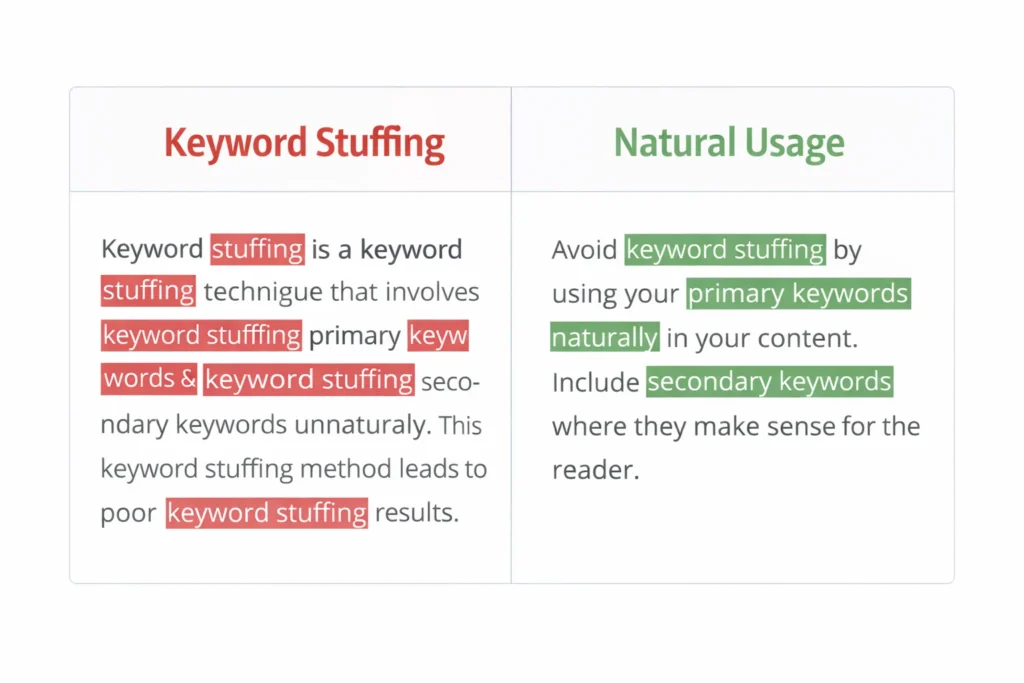
Keyword stuffing happens when you sacrifice readability for keyword frequency. I often see content where writers obsess over keyword density instead of following SEO best practices, using their target keyword in every sentence and making the text feel robotic and forced.
A clear example would be: “SEO keywords are important. SEO keywords help rankings. You need SEO keywords for traffic. Learn about SEO keywords here.” This repetitive pattern destroys the natural flow that readers expect.
I’ve found that keyword stuffing often occurs when writers focus on keyword density percentages instead of helpful content creation. The obsession with hitting specific keyword frequency targets leads to unnatural writing that Google penalizes.
The User Experience Connection
User experience and SEO success are inseparable in modern search algorithms. When keyword stuffing makes content hard to read, visitors spend less time on your page and engage less with your content.
The Google algorithm specifically monitors these website performance metrics to determine content quality. These metrics directly influence your search rankings. Content that prioritizes keywords over readability consistently performs worse in these crucial areas.
I always remind myself that I’m writing for humans first, search engines second. When content helps real people solve real problems, the SEO results follow naturally. The reverse approach rarely works in today’s competitive landscape.
Where and How to Place Your Keywords Naturally
I follow a strategic keyword placement framework that puts my primary keyword in high-impact locations without sacrificing readability. The key to achieving optimal keyword density is using common sense to check whether keyword placement feels forced or natural.
The Rule of Five guides my keyword placement strategy. I include my main keyword about five times across the entire post, which typically means once every 200-300 words in longer articles. This frequency feels natural to readers while giving search engines clear topic signals, and these guidelines help when you implement your keyword strategy on WordPress pages.
Strategic placement matters more than frequency. I prioritize including my primary keyword in my H1 title tag, at least one H2 heading, my meta description, and naturally within the content body. These locations carry the most SEO weight.
The Strategic Placement Framework
Title tags and meta descriptions are my highest priority locations for primary keyword placement in on page SEO. Search engine bots scan these meta tags first to understand page content, making them crucial for ranking potential.
I always include my primary keyword in my H1 heading and at least one H2 subheading. Header tags help organize content structure while reinforcing my main topic for both readers and search engines.
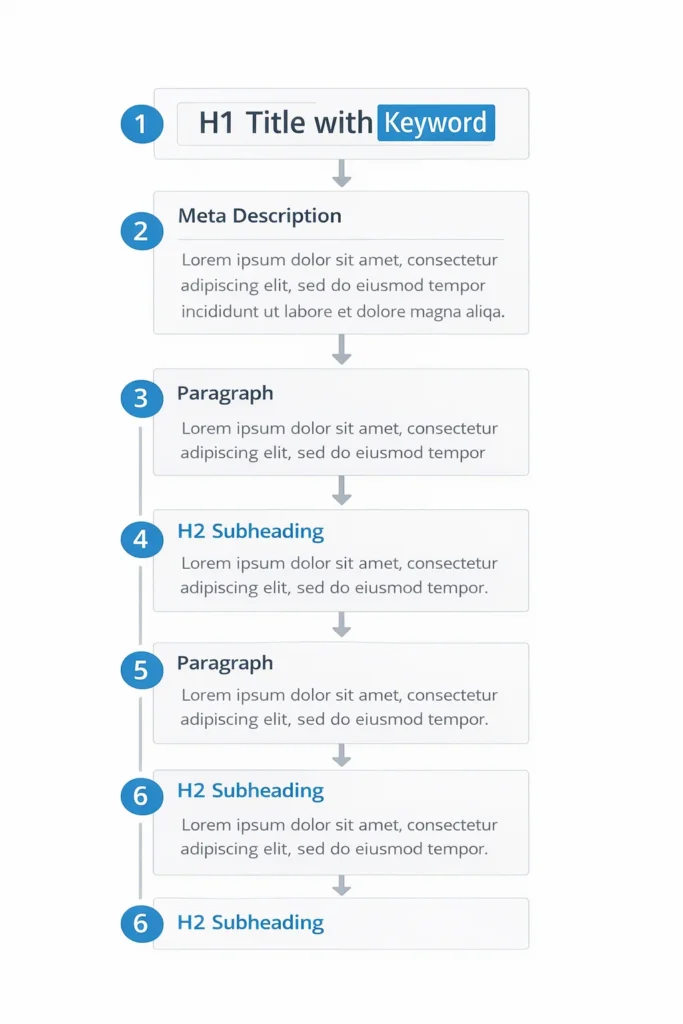
The opening paragraph is another strategic location where I naturally introduce my primary keyword. This placement helps establish topic relevance early while maintaining a conversational tone that welcomes readers.
How Many Meta Keywords Should You Use for SEO?
Meta keywords tags are no longer used by Google for ranking purposes, so I don’t focus on them anymore. However, meta descriptions remain crucial for click-through rates and should include your primary keyword when it fits naturally.
I optimize my meta descriptions to include my primary keyword plus compelling copy that encourages clicks. The goal is balancing SEO signals with persuasive messaging that stands out in search results.
Focus your meta optimization energy on writing descriptions that accurately represent your content while incorporating your primary keyword naturally. This approach improves both SEO performance and user experience.
The “Common Sense” Check Method
I always read my content aloud to check whether keyword placement sounds natural. If my target keyword feels forced or makes sentences awkward, I rewrite those sections to flow more like natural language. This content creation approach ensures readability comes first.
The common sense check involves asking whether a real person would talk about the topic this way. When keyword placement disrupts natural conversation flow, it’s time to adjust your approach.
I also consider whether each keyword mention adds value to the reader. If I’m including keywords just for SEO without providing additional context or information, I remove those instances to improve content quality.
Advanced Strategy: The Long-Tail Multiplication Effect
One well-crafted long-tail phrase can effectively target multiple shorter keywords simultaneously. I use this strategy to rank for 4-5 related keywords with a single optimized piece of content.
By creating one comprehensive long-tail phrase like “digital marketing service provider in Delhi,” I naturally target shorter keywords like “digital marketing,” “marketing service,” and “Delhi marketing.” This multiplication effect maximizes my SEO efficiency.
Long tail keywords often have less competition and higher conversion rates than shorter, more generic terms. I’ve found that targeting these specific phrases brings more qualified traffic that’s closer to making purchasing decisions.
How One Long-Tail Phrase Captures Multiple Keywords
The key to effective keyword targeting is choosing long-tail phrases that naturally incorporate your desired shorter keywords. When I optimize for “best email marketing software for small businesses,” I simultaneously target “email marketing software,” “marketing software,” and “small business software.” This approach captures multiple related search queries with one comprehensive piece.
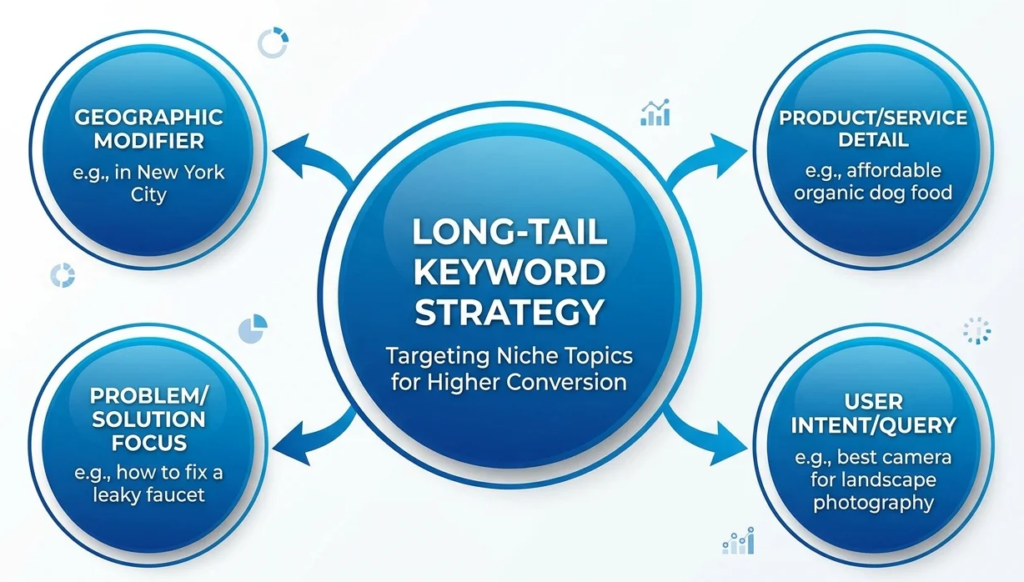
Search engines recognize these semantic relationships, often ranking my page for both the long-tail phrase and shorter component keywords.
This strategy works particularly well for local SEO and product-specific searches. Long-tail phrases that include location or specific product features tend to capture multiple related search queries effectively.
Tools and Research: Finding Your Perfect Keyword Mix
I use specialized tools like NeuronWriter and Surfer SEO to identify which NLP keywords are missing from my content. Conducting a thorough WordPress SEO audit using these tools alongside competitor analysis helps reveal keyword gaps and optimization opportunities.
My research process starts with looking at top-ranking URLs to see which keywords they’re actually ranking for. Then I identify modifiers and related terms that I can naturally incorporate into my own content.
Google Search Console provides invaluable data about which keywords already drive traffic to my existing content. I use this information to optimize underperforming pages and identify new content opportunities.
Using NLP Keyword Tools (NeuronWriter, Surfer SEO)
These advanced SEO tools perform comprehensive keyword analysis on the semantic keyword landscape around your topic. I input my primary keyword, and these tools show me related terms that top-ranking pages commonly include. Using professional SEO tools gives you insights that manual research often misses.
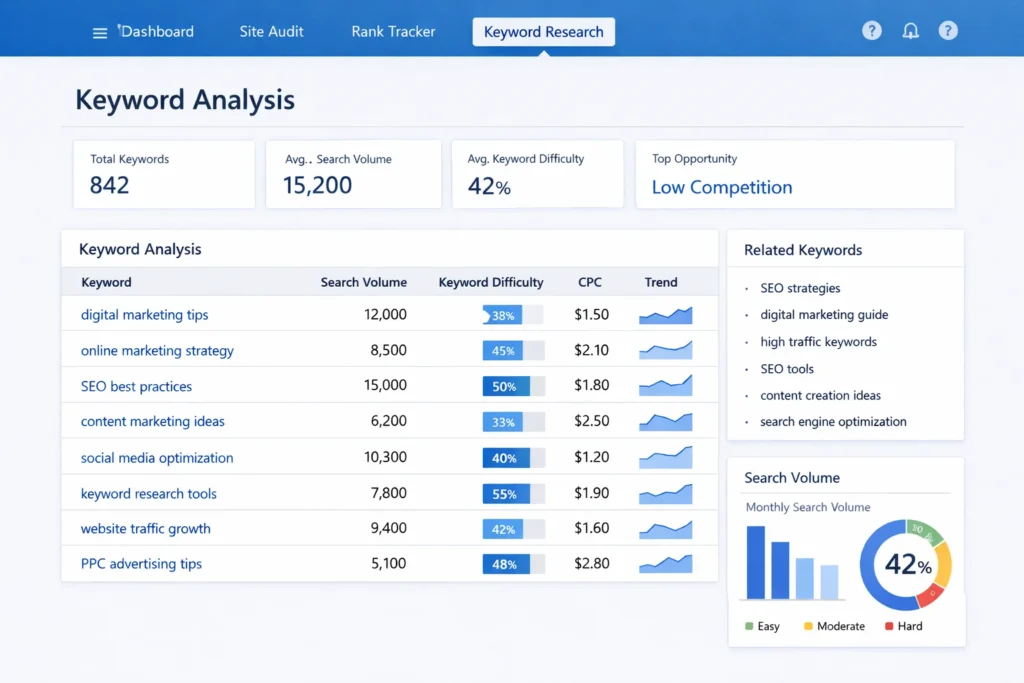
The workflow I follow involves running my competitor’s top-performing content through these tools to see their strategy. This reveals gaps in my own keyword strategy that I can fill to improve topical coverage.
SEO plugins like Yoast provide basic keyword optimization guidance, but dedicated NLP tools offer much deeper insights into semantic keyword opportunities that most content creators miss.
The Competitor Modifier Extraction Method
I systematically analyze competitor content to identify keyword modifiers they use successfully as part of my content strategy. These modifiers often become excellent secondary keywords for my own content, improving my overall search optimization approach.
The process involves examining the top 10 results for my target keyword and noting common terms, phrases, and question patterns they include. This research reveals what Google considers comprehensive coverage of the topic.
I create a keyword research spreadsheet that captures primary keywords, secondary keywords, and modifiers from competitor analysis. This document becomes my blueprint for creating more comprehensive content than what’s currently ranking.
Content Type Strategy: Blog Posts vs Pages vs Landing Pages
Different content types require different keyword optimization approaches. I adjust my strategy based on whether I’m creating blog posts, service pages, or landing pages for specific campaigns.
Blog posts allow for more secondary keyword diversity since they’re typically longer and more comprehensive. I coordinate with content writers to ensure proper keyword implementation across different content formats.
Landing pages and service pages should focus on one specific subject to provide maximum value for both users and search engines. This focused approach as demonstrated in service page keyword strategy for local businesses typically converts better than trying to rank for multiple topics on a single page.
Blog Post Keyword Strategy
When determining how many keywords per page to use, blog content works best with one primary keyword supported by 5-7 secondary keywords that naturally relate to the main topic. This content marketing approach allows for comprehensive topic coverage while maintaining clear search intent.
I structure blog posts to answer multiple related questions about my primary keyword. Each section can target a different secondary keyword while supporting the overall topic authority of the page.
Content marketing through blogs requires balancing keyword optimization with reader engagement. I prioritize creating content that people want to read and share, knowing that user engagement signals influence search rankings.
Landing Page Optimization
Landing pages benefit from tighter keyword focus since they’re designed for specific conversion goals. My page optimization approach focuses on selecting relevant keywords typically one primary keyword plus 2-3 highly relevant secondary keywords that match user intent and support the conversion process.
Page optimization for landing pages emphasizes matching search intent with user goals. When someone searches for my target keyword, my landing page should immediately show them they’re in the right place.
Local SEO and service pages work particularly well with location-based keywords. I include city names, service areas, and local modifiers that help these pages rank for geographically relevant searches.
How to Track and Measure Your Keyword Success
I focus on Google Analytics and other SEO metrics rather than individual keyword rankings because website ranking positions vary by location and personalization, making them unreliable for measuring real performance.
Instead of obsessing over keyword positions, I monitor page views, time on page, bounce rate, and conversion metrics. These numbers show me whether my SEO work actually brings in real business results.
Google Search Console shows which queries bring traffic to my pages, revealing successful keyword optimization that I might not have intentionally targeted. This data helps me double down on what’s working.
Why Keyword Rankings Lie (And What to Track Instead)
Individual search rankings change constantly based on user location, search history, and device type. What I see when I search for my keywords in organic search isn’t necessarily what my potential customers see in their search engine results.
Website performance metrics like organic traffic growth, engagement rates, and conversion percentages tell a more accurate story about keyword success. These numbers directly connect SEO efforts to business outcomes.
I track ranking improvement trends over time rather than daily position changes. Monthly or quarterly ranking data provides more meaningful insights than the daily fluctuations that can drive SEO anxiety.
Common Keyword Mistakes That Tank Your Rankings
The biggest mistake I see is forcing the same keyword multiple times in a single paragraph, which can trigger a keyword stuffing penalty. This practice immediately signals over-optimization to search engines and creates a poor reading experience for users. Avoiding this mistake is essential for ranking improvement.
Using the same keyword 50 times throughout an article will get you penalized for spam. I’ve seen well-intentioned content creators destroy their rankings by obsessing over keyword density instead of content quality.
Keyword cannibalization occurs when multiple pages compete for the same keywords. This internal competition prevents any single page from ranking as high as it could if it were the only page targeting those terms.
The Single-Paragraph Stuffing Trap
Paragraph-level keyword stuffing happens when writers try to include their target keyword in every sentence of a paragraph, disrupting natural keyword frequency. This creates unnatural repetition that damages content structure and gets noticed immediately by both readers and search engines.
The solution is spreading keyword mentions throughout your entire article rather than concentrating them in specific paragraphs. Natural keyword distribution feels more conversational and provides better user experience.
I always check my content for sections where the same keyword appears multiple times within a few sentences. These sections usually need rewriting to improve flow and reduce over-optimization signals.
Keyword Cannibalization: When Pages Compete
Multiple pages targeting the same primary keyword split their potential ranking power instead of combining it. I’ve seen websites with dozens of pages competing for identical keywords, preventing any page from reaching its full ranking potential.
The fix involves consolidating similar content or clearly differentiating the target keywords for each page. Content strategy should ensure each page has a unique primary keyword that doesn’t compete with other site pages.
I regularly audit my website for keyword cannibalization using Google Search Console data. When I find multiple pages ranking for the same terms, I either merge the content or modify the keyword targeting to eliminate competition.
Frequently Asked Questions
How many times should I use my primary keyword in a 2000-word article?
I recommend using your primary keyword about 5 times total in a 2000-word article, following the “Rule of Five.” This works out to roughly once every 200-300 words. Focus on natural placement in your title, headers, and throughout the content rather than hitting an exact count. Reading your content aloud helps ensure keyword usage feels conversational rather than forced.
What tools should I use to find NLP keywords that my competitors are ranking for?
NeuronWriter and Surfer SEO are the best tools for competitor keyword analysis and NLP keyword discovery. These tools analyze top-ranking content to reveal semantic keywords and content gaps. For free alternatives, use Google Search Console to see which terms already drive traffic to your site, and analyze competitor content manually to identify commonly used modifiers and related terms.
Can I use the same primary keyword on multiple pages of my website?
No, using the same primary keyword on multiple pages creates keyword cannibalization where your pages compete against each other instead of ranking higher. Each page should target a unique primary keyword to maximize your site’s overall ranking potential. If you need to target similar topics, use different keyword variations or focus on different aspects of the broader topic.
Should I track keyword rankings or focus on other metrics?
Focus on Google Analytics metrics like page views, time on page, bounce rate, and conversions rather than daily keyword rankings. Rankings vary by location, device, and personalization, making them unreliable for measuring real performance. These user engagement metrics provide better insights into whether your keyword strategy actually drives business results and satisfy search intent.
How do I know if I’m keyword stuffing my content?
Use the “common sense check” by reading your content aloud to see if keyword usage feels forced or unnatural. If mentioning your keyword makes sentences awkward or repetitive, you’re likely over-optimizing. Another red flag is using the same keyword multiple times within a single paragraph. Quality content should read like natural conversation while incorporating keywords seamlessly.
What’s the difference between SEO keywords and LSI keywords?
SEO keywords are the specific terms you directly target for rankings, while LSI (Latent Semantic Indexing) keywords are semantically related terms that help Google understand your topic context. LSI keywords include synonyms, related phrases, and terms commonly found in content about your main topic. Modern Google uses these semantic relationships to better understand content relevance and rank pages for multiple related queries.
Conclusion: Getting Your Keyword Strategy Right
Understanding how many SEO keywords should I use comes down to quality over quantity. Focus on one strong primary keyword supported by relevant secondary keywords that naturally enhance your topic coverage. This approach builds topical authority while avoiding the penalties that come with keyword stuffing.
Remember that successful SEO isn’t about gaming the system with perfect keyword density. It’s about creating genuinely helpful content that answers your audience’s questions while following search optimization best practices. When you get this balance right, the rankings and organic traffic follow naturally.