
SEO for dental practices used to be an afterthought. Not anymore. Here is the number that changed how I approach every client onboarding: according to research by Bright Local, 77% of patients use the internet to find healthcare providers and studies consistently show that over 90% of searchers never scroll past page one of Google results. If your practice is not showing up in those top results, you are not losing to a better dentist. You are losing to a better-ranked one.
I have watched this play out firsthand. A practice with stellar reviews, an experienced team, and a genuinely beautiful office was being consistently outranked by a competitor with half the credentials — simply because that competitor had invested in local SEO and my client had not. The visibility gap was costing them an estimated 20 to 30 new patient inquiries every single month.
What makes search engine optimization for dentists more achievable than most industries is that it is fundamentally local. Unlike national SEO where you are up against thousands of websites with massive budgets dental industry competition is geographically bounded. You are competing in a 10 to 15 mile radius. That is a winnable fight, and this guide walks you through exactly how to win it.
Why Local SEO for Dental Practices Is 80% of Your Ranking Strategy
Local SEO for dental practices operates on a different logic than SEO for national brands. When someone searches for a dentist, they want someone within driving distance convenience and accessibility trump almost every other factor. That single reality shapes everything about your dental practice SEO strategy.
Your primary battleground is the local pack: that three-listing map section that appears at the top of Google search results for queries like “dentist near me.” In dental local search, those three map spots capture the dominant share of clicks every other position on the page is competing for what is left.
This is why local optimization is not just important; it is where your first 60 days of effort should be concentrated. Understanding the mechanics of local SEO rankings at a deeper level will help you prioritize your efforts strategically.
I saw this shift work for a practice that had been investing heavily in blog content and backlinks. Good work but the wrong priority order. Once they pivoted to local pack optimization, they started fielding new patient calls within three weeks. The blog content still mattered, but it would have taken months to produce the same result on its own.
Understanding the Local Pack: Where Your Patients Find You First
When a potential patient types “dentist near me” or “emergency dentist in Austin” into Google, they see a map with three local business listings before they see any regular website results. This is the local pack and the people clicking on it are your highest-value prospects. They are not doing casual research. They are ready to call.
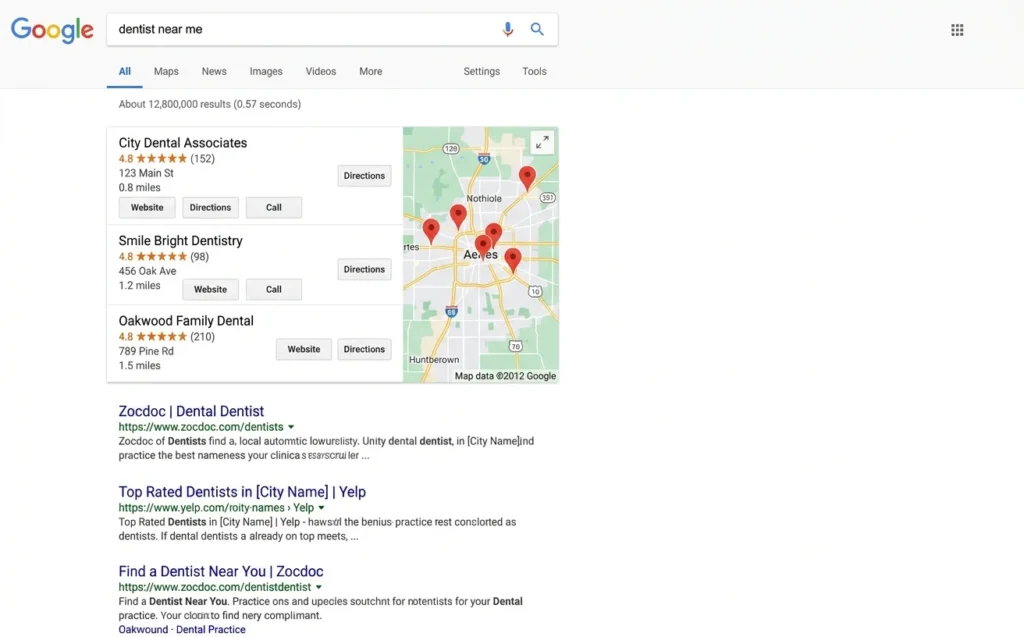
Because the local pack sits above all organic results, it captures attention before anything else on the page. Local search algorithms specifically weight proximity, relevance, and prominence to determine which three listings appear in the map pack and your Google Business Profile is the primary input for all three factors. Dental office discoverability in local search begins and ends with those three positions if you are not in them, you are invisible to the majority of high-intent searchers.
Understanding how local search works is the foundation of your entire dental practice digital marketing approach. Everything from your Google Business Profile to your reviews to your citation listings feeds into these three coveted map positions.
Google My Business: The Foundation of Everything
Google My Business SEO for dentists is not a side task it is the most direct lever you have over your Google rankings. Every element patients see in the local pack map view your address, phone number, hours, services, photos, and reviews is pulled directly from your GMB profile. You own this data entirely. You control it. And dental office SEO optimization of your GMB profile requires no agency, no budget, and no technical expertise.
When I first started auditing dental practices’ online presence, the pattern was consistent: the practices struggling to get found had incomplete, neglected GMB profiles. The practices fielding 30, 40, or 50 new patient calls per month had profiles that were meticulously filled out and actively maintained. That correlation is not coincidence it is Google rewarding practices that give it accurate, complete, and up-to-date information to serve users.
Think of your GMB profile as your digital storefront. Before a patient ever visits your website, they have already seen your GMB listing. The impression it makes or fails to make determines whether they call you or move on to the next result.
The Review Ranking Factor: Why 500 Reviews Beats Better Content
Of all the patient review signals Google weighs for local rankings, volume and consistency matter most more than a polished website, more than thousands of words of blog content, and more than a backlink profile your SEO agency spent months building.
The fastest way to stand out as a dentist online is not a website redesign or a new service page campaign it is a review profile that makes competitors look inactive by comparison. I worked with a practice that had accumulated 900 Google reviews and a website I would describe as mediocre. It consistently outranked competitors who had invested far more in design and content. Google interprets high review volume as authentic social proof from real patients a signal that is very difficult to manufacture at scale, which is exactly why Google trusts it so heavily.
For your dental practice’s online authority and local rankings, reviews are your most powerful lever and unlike most ranking factors, you can directly influence them through systems built into your daily workflow. That is exactly what the next section covers.
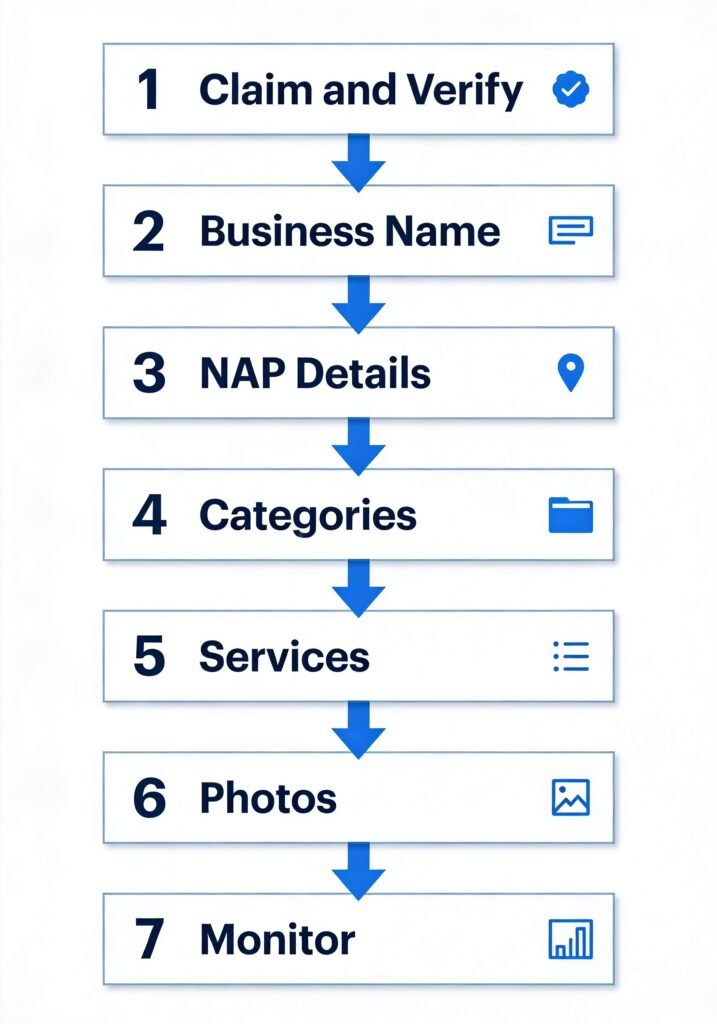
How to Optimize Your Google My Business Profile in 7 Steps
GMB optimization is entirely within your control no permission from Google required, no waiting on algorithm updates. Make the right changes today and you can expect to see visibility shifts within two to four weeks. The following seven steps cover the exact process.
Step 1: Claim and Verify Your Google My Business Listing
First, check whether your practice is already listed on Google. Search for your practice name and address. If it appears in Google Maps or the local pack, it already exists.
If you do not already own your listing, claim it immediately. Go to google.com/business. Search for your practice. If it exists, claim it. If it does not, create it. Standard verification happens through mail — Google sends you a postcard with a verification code. Enter that code to confirm ownership.
Note: Google also offers phone or video verification for some listings — if offered, these are faster than waiting for a postcard.
This takes five minutes to initiate. The actual verification takes a few days. Do this today.
Step 2: Fill Out Your Business Name Correctly (No Keyword Stuffing)
One of the most common mistakes I see when auditing dental GMB profiles is keyword-stuffed business names: “Smith Dental Implants Root Canals Whitening Emergency Dentistry Austin Texas.” Do not do this.
Google’s current algorithm actively detects keyword stuffing in business names and applies ranking penalties. Use your actual practice name if it is Smith Dental Clinic, that is what goes in the field. Keywords belong in your service descriptions and page content, where they are meant to be. Google identifies what you offer through your categories and services; you do not need to cram it into your name.
Step 3: Ensure Your Address, Hours, and Phone Are 100% Accurate
This seems basic, but I have seen practices get this wrong repeatedly and it costs them. In SEO terms, this consistency is called NAP accuracy: Name, Address, Phone. It is a foundational trust signal for your dental office local listings across every directory, review platform, and citation source on the web.
Your address needs to match your actual office location exactly. If you list different addresses on different sites, Google gets confused and confused signals lower trust. Hours need to match your real operating schedule. If you say you are open until 5 PM but actually close at 4 PM, that friction drives patients away when they arrive to a locked door.
Phone numbers should be a direct line to your office where possible. Make it easy for interested patients to actually reach a human.
Step 4: Set the Right Primary and Secondary Categories
Your primary category should be “Dentist” in almost every case. This is your main business type.
You can add up to ten additional categories, and these should reflect your specialties and services. If you offer cosmetic dentistry, add “Cosmetic Dentist.” If you handle pediatric patients, add “Pediatric Dentist.” If you offer emergency services, add “Emergency Dental Service.”
Specific secondary categories help you rank for service-specific searches. Someone searching “cosmetic dentist near me” is far more likely to find your practice if you have claimed that category than if you are listed only as a general dentist.
Step 5: Add Service Descriptions (Up to 100 Services)
This is one of the most underused ranking levers in GMB optimization. You can add up to 100 individual services, each with its own keyword-rich description. Treat each service as one of your dental keywords to target a dedicated search signal that tells Google exactly what procedures you offer.
When you add “Dental Implants” with a description like “Replace missing teeth with permanent dental implants. Dr. Smith has 15 years of implant experience. Same-day consultation available,” Google indexes that content. Following the principles of keyword-rich descriptions ensures your service offerings appear in relevant searches.
Prioritize your core 10 to 20 services with detailed descriptions: Root Canal Treatment, Teeth Whitening, Invisible Braces, Emergency Extraction, and Gum Disease Treatment are strong starting points. Each one reinforces your topical relevance in local search. This activity takes an afternoon and often shows ranking improvement within two to four weeks one of the strongest time-to-ROI ratios available in dental practice digital marketing.
Step 6: Upload 8 to 10 High-Quality Photos
Google tracks the volume and quality of images on your GMB profile, and profiles with consistent, authentic photography rank noticeably higher than those with few or outdated photos.
Upload images that reflect your actual practice: office exterior, waiting room, treatment rooms with equipment visible, staff photos with names and titles, and before-and-after patient results with written consent. Whenever possible, take these photos on-site using your phone. Google reads the geo-tag data embedded in mobile images and treats on-site photography as an authenticity signal — it shows you are a real, active practice, not a listing populated with stock imagery.
Refresh your photos quarterly. Consistent updates signal to Google that your business is actively managed, which factors into local ranking decisions.
The Science of Review Generation: How Practices Get 500+ Reviews
Reviews are your ranking multiplier. Everything else you do with SEO for dental practices matters, but reviews move local search rankings faster and more predictably than any other factor.
What separates practices with 500 or more reviews from those with 50 is rarely luck it is process. The practice with 900 reviews I mentioned earlier did not accumulate them by hoping patients would voluntarily log into Google and write something. They built a review generation system into their daily workflow, and it ran consistently regardless of who was at the front desk that day. That is what this section will show you how to build.
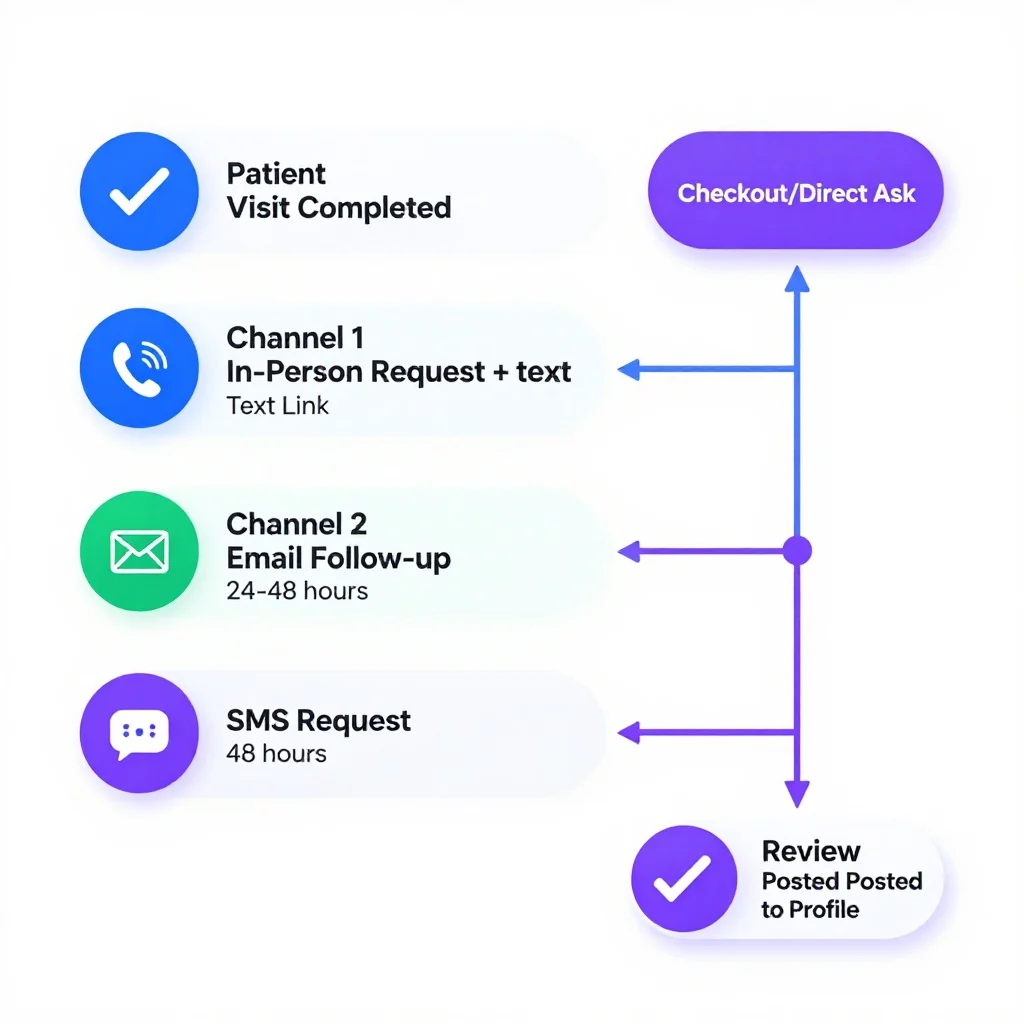
The Direct-Ask Method: How to Generate 20 to 30 Reviews Per Month
The most effective review generation method does not involve contests, prizes, or incentives it is simpler and more sustainable than that. It is a direct, personal ask at the right moment.
Train your front desk team to identify satisfied patients as they check out and ask them directly:
“It looks like you had a great experience today. We would really appreciate it if you took two minutes to leave us a Google review it genuinely helps other patients find us. I can text you the direct link right now if that is easier for you.”
That is the entire script. The moment matters ask while the positive experience is still fresh. Offering to text a direct link removes the friction of searching for your profile. A practice with one hygienist using this method consistently can generate 20 to 30 authentic reviews per month.
One critical compliance note: Google’s review policies explicitly prohibit offering incentives including prizes, discounts, or any form of gifts in exchange for reviews, regardless of whether those reviews are positive or negative. Practices that use incentivized review schemes risk having their entire review profile removed or their Google Business Profile suspended. Every review you earn must be authentic. This is not just best practice it is the only compliant path.
Email and SMS Follow-Up Review Requests
Automated email requests also work, though in-person requests consistently outperform them. After a patient visit, send an email with a subject line like “Thank you for choosing Smith Dental Clinic”:
“Thank you for your visit. We appreciate your trust in our team. If you had a positive experience, we would be grateful if you could leave us a Google review using the link below. Your feedback helps other patients find quality dental care in our community.”
SMS requests have significantly higher open rates than email. Send the same message to patients who have provided prior written consent to receive SMS communications. This is a legal requirement under TCPA regulations SMS review requests should go only to patients who explicitly opted in, not to your entire patient list.
The key to both channels is removing friction. Provide a direct link to your Google review page. Never ask patients to search for you themselves.
Responding to Reviews: The Overlooked Ranking Factor
Responding to reviews is a ranking factor most dental practices completely overlook. Practices that turn review volume into ranking power have one thing in common: they respond to every single review — positive or negative within 48 hours.
For positive reviews, make your response specific rather than generic. Instead of “Thank you for your kind words,” try: “Thank you for mentioning our hygienist Sarah she genuinely cares about every patient and we are lucky to have her on the team.” Specificity signals to Google that the response is authentic, not automated.
For negative reviews, keep it brief, professional, and resolution-focused. Something like: “Thank you for sharing your experience. I am sorry your visit did not meet our standards. Please call us directly so we can make this right.” You are not debating. You are not defending. You are demonstrating that your practice is managed by people who genuinely care and that signal matters to both Google’s algorithm and future patients reading your profile.
Response velocity matters to Google’s algorithm. A business that responds quickly signals active management and patient-centric values.
Dental Website SEO: Technical Setup That Converts Traffic into Patients
Once your GMB profile is optimized and your review generation system is running, dental website SEO becomes your next priority area. There is a distinction worth making upfront: on-page optimization for dental websites must serve two masters simultaneously Google’s ranking algorithm and the patient who landed on your page and is deciding whether to call.
I have audited practices sitting at the top of local search results, generating hundreds of monthly visitors, and fielding almost no calls. Their dental practice search visibility was excellent. Their dental website conversion rate was terrible. These are two separate problems, and conflating them is one of the most common strategic mistakes I see. Fortunately, conversion problems are among the most fixable issues in all of SEO.
Title Tags and Meta Descriptions: The CTR Drivers
Your title tag is the blue headline that appears in Google search results and it is one of the most direct influencers of your dentist website ranking for any given search query. Your meta description is the gray text below it. Together, these two elements determine whether someone clicks on your result or scrolls to a competitor.
Use this title tag format: [Service] in [City] | Practice Name. Examples:
- “Dental Implants in Austin | Smith Dental Clinic”
- “Root Canal Treatment in Dallas | Crown Dental Care”
- “Emergency Dentist in Houston | City Center Dental”
Keep title tags under 60 characters to prevent truncation in search results, and keep meta descriptions between 140 and 155 characters. Truncated titles and descriptions reduce click-through rates significantly.
Meta descriptions should include your keyword, a benefit, and a call to action: “Professional dental implants in Austin with same-day consultation. Dr. Smith has 15+ years of implant experience. Book your appointment today.”
According to studies by Backlinko and Advanced Web Rankings, optimizing title tags and meta descriptions for clarity and relevance can increase organic click-through rate by 15 to 30% at identical ranking positions meaning you convert more of the traffic you already have without any change to your rankings.
Mobile Responsiveness: Non-Negotiable for Local Searches
Over 70% of dental searches happen on mobile devices. Your website must be fully responsive it needs to work cleanly on phones, tablets, and desktops without compromise.
Google prioritizes mobile-friendly sites because of mobile-first indexing the principle that Google uses your mobile site, not your desktop site, as the primary version for ranking purposes. If your mobile site is slow, broken, or hard to navigate, your rankings suffer regardless of how good your desktop experience looks.
Test your site on actual devices, not just your computer’s browser preview. Make sure buttons are large enough to tap comfortably the minimum recommended size is 44 by 44 pixels, roughly the width of your thumb.
The Clickable Phone Number Fix: Critical Conversion Lever
One of the most common conversion killers on dental websites is a phone number that is not clickable. A patient finds your site on their phone, sees your number, and has to manually type it into the dialer. A significant portion of those patients give up before finishing.
Make phone numbers clickable using HTML tel: links. The code looks like this:
<a href="tel:+15121234567">512-123-4567</a>When patients tap, their phone dialer opens immediately with your number pre-filled. One small technical fix, implemented in 15 minutes, can produce a 10 to 20% improvement in phone conversions.
Add a prominent “Call Now” button in your header as well. Make it high-contrast and visible at the top of the page on every mobile screen.
Clear Call-to-Action Design
Your call-to-action should be impossible to miss. High-contrast blue or green buttons typically outperform other colours in dental website testing. Button text matters as much as placement replace vague labels like “Learn More” with specific directives: “Book Appointment,” “Call Now,” or “Schedule Your Consultation.”
Place CTAs in multiple locations: your hero section at the top of the page, a sticky header that remains visible as users scroll, your footer, and within each service description. For even better conversion, consider integrating appointment booking systems that allow patients to schedule directly from your website. Dental website conversion rates improve significantly when there is no ambiguity about what a patient should do next every page should make the path to booking completely frictionless.
Page Speed Optimization: Target Under 3 Seconds
Page speed is one of several user experience signals Google measures through its Core Web Vitals system — a set of metrics that directly influence both rankings and how visitors interact with your pages. Slow sites rank lower and convert worse than fast sites at any ranking position.
Use Google PageSpeed Insights, which is free and provides specific, actionable recommendations. Compress images to under 200KB each. Remove unnecessary JavaScript that loads before your page becomes interactive. Enable browser caching so returning visitors load your site faster.
If you are on WordPress, a caching plugin and content delivery network can make a substantial difference. Target under three seconds for full page load on mobile. If you are above five seconds, fixing speed is your highest-priority website task.
Service Pages and Location Pages: The Smart Content Framework
Most dental practices make the same content mistake: they write educational blog posts about “What is a Root Canal” or “How to Floss Properly” and expect those pages to generate appointment bookings. They will not at least not directly.
Understanding dental search intent is what separates content that generates phone calls from content that generates page views with no conversion. Dental patient search behavior follows a clear pattern: someone searching “root canal treatment in Austin” is in decision mode they already know what they need, they want to find a provider, and they are ready to call. Someone searching “what is a root canal” is still learning they may call someone eventually, but not today, and not from a generic educational page.
Your primary content energy belongs on service pages that capture decision-mode searchers. Ranking for dental keywords that actually convert “dental implants near me,” “same-day emergency dentist Austin” requires dedicated service pages, not general blog posts.
Why Service Pages Beat General Blog Posts for Local Dental Ranking
A dedicated “Dental Implants in Austin” page will outrank a generic “What Are Dental Implants” blog post for local searches every time. It will also convert better by a wide margin.
Service pages are built to attract dental patients online who are in decision mode, while educational blog posts speak to patients who are still researching. Content relevance and quality determine whether your service page ranks and converts Google uses both signals to decide whether your page deserves the top position, and patients use both to decide whether to call.
Service pages should be commercial in nature, not educational. The goal is convincing a patient who is already interested in your service that your practice is the right choice. Show them your experience. Show them patient results. Show them exactly why they should choose you over your competitors.
The High-Converting Service Page Blueprint
Create a dedicated service page for each major service you offer. Use this structure consistently:
Compelling Headline : “Dental Implants in Austin: Permanent Tooth Replacement by an Experienced Implant Specialist” include your service and city in the headline.
Hero Image : Your practice, your dentist, satisfied patients with consent, or before-and-after results.
Service Explanation : One to two paragraphs explaining the service and its benefits. Use dental terminology accurately but translate it into patient-friendly language. Not “a dental implant is a titanium post” but “a permanent artificial tooth that looks, feels, and functions like your natural tooth.” Focus on the outcome the patient wants, not the clinical process.
Why Choose Us : Three to five specific competitive advantages: your experience, your technology, your patient satisfaction rates, your turnaround times.
The Process : Four to five clear steps from consultation through completion. Patients are anxious about procedures they do not understand. A clear process reduces that anxiety and improves conversion.
Before and After Gallery : Real patient cases with written consent. These are among the most powerful proof elements for cosmetic and restorative services.
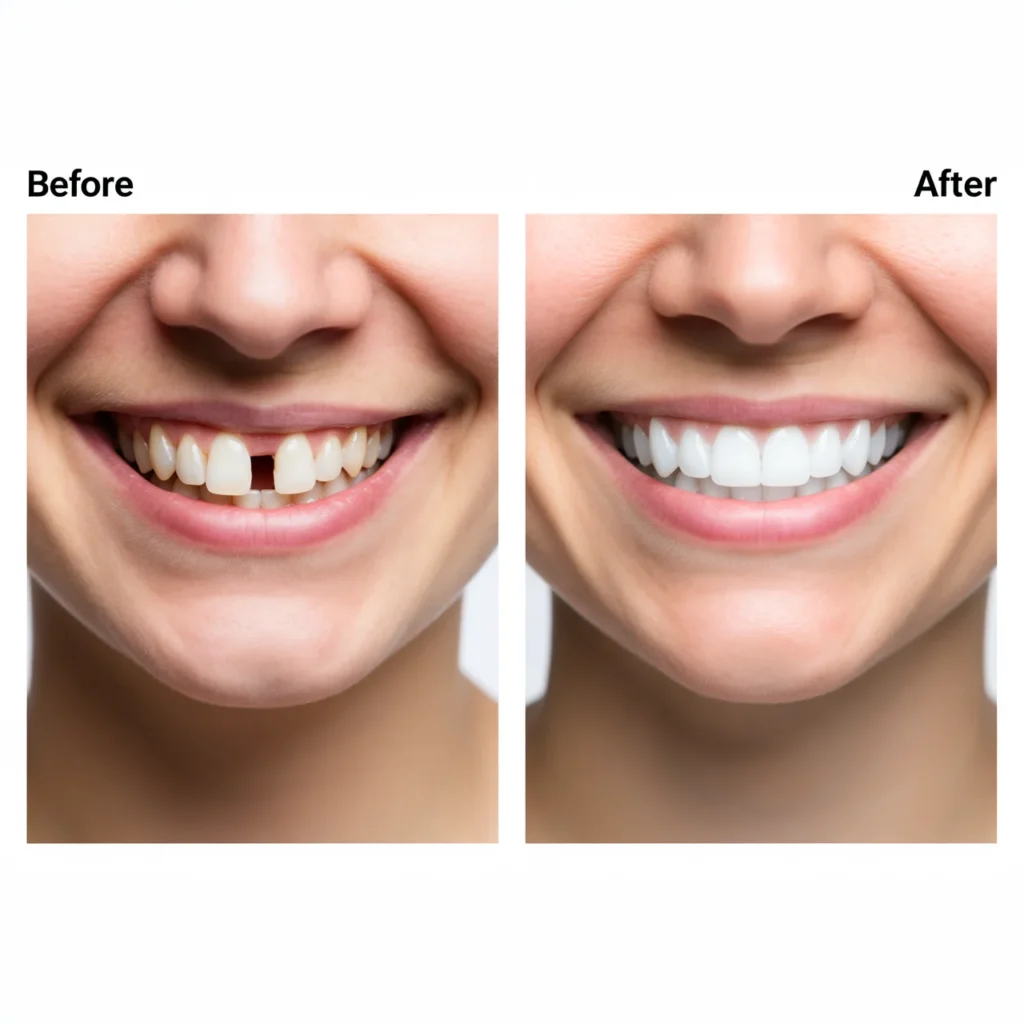
Patient Testimonials : Video testimonials produce the strongest conversion lift. Written testimonials work well when they are specific and include the patient’s first name and photo.
FAQ Section : Five to seven questions patients actually ask about this service. Write each answer as a complete, standalone response of 40 to 60 words. Consider using an organized FAQ section format with expandable content to improve user experience and page organization. This format also improves your eligibility for Google’s AI Overview summaries at the top of search results.
Clear CTA : High-contrast button: “Schedule Your Consultation.” Your phone number visible directly below it.
Following this structure consistently across all your service pages is one of the core dental SEO best practices for converting local search traffic into booked consultations. I have seen practices double their appointment bookings simply by switching from blog-first content to a service-page-first approach.
Location Pages: Dominating Multiple Areas
If you serve multiple neighbourhoods or surrounding cities, create location-specific pages. “Dentist in Green Hills Nashville,” “Dentist in Brentwood Tennessee,” “Dentist in Franklin Tennessee” — each page targets that specific geographic area. Managing multiple locations within your SEO strategy requires a structured approach to ensure each location page is optimized and distinct.
Include local information that makes each page genuinely unique: neighborhood characteristics, nearby landmarks, community events, demographics, local schools. This signals to Google that you have real knowledge of and presence in that area.
Location pages allow you to extend your dental office discoverability across multiple neighborhoods without requiring additional physical offices. A practice with one location can rank in eight to ten surrounding areas by creating location-specific pages. Understanding how to structure and optimize these service pages and location pages within your website architecture is crucial for maximizing geographic reach.
One important caution: each location page must have genuinely unique content. Pages that are copy-paste duplicates with only the city name swapped are treated by Google as thin content and filtered out of rankings. True location pages take more time to build, but the payoff is significantly greater.
Building Hyperlocal Content: The 80% of Blog Strategy That Builds a Moat
Of the blog content you create, make 80% hyperlocal. This is your competitive moat because competitors in other cities, and agencies working from other markets, cannot replicate it authentically.
Write about your specific community: “The History of Downtown Nashville,” “Best Family Restaurants in Brentwood,” “Parks and Playgrounds in Green Hills,” “Local Events Happening in Franklin This Month,” “A Guide to the Gulch Neighbourhood.” Make this content genuinely useful you are not just inserting city names into templates, you are contributing real local knowledge.
Make the remaining 20% educational and broadly applicable: “How to Floss Properly,” “What to Expect During a Root Canal,” “Why Your Teeth Are Sensitive After Whitening.”
The 80/20 split builds deep geographic relevance and authority. This is one of the most sustainable ways to grow your dental practice with SEO over time you are not just a dentist in a city, you are a community resource with a track record of useful, locally grounded content.
Building Dental Authority: Citations, Links, and Press Releases
Once your website foundation is solid, off-page signals take over as your primary growth lever. This is where backlink building, citation consistency, and strategic press releases compound the local foundation you have already built.
Citations are directory listings entries on platforms like Yelp, Health grades, and Zoc Doc that list your practice name, address, and phone number. They are foundational for your dental practice’s online authority because they tell Google your business is real, established, and consistently represented across the web. Backlinks are links from other websites pointing to yours effectively external endorsements. The quality and relevance of the linking site determines how much ranking power that link passes to you.
Most practices either ignore off-page SEO entirely or build links without a strategic framework. What follows is the framework that actually moves rankings.
Building Local Citations: The Foundation of Trust
Building consistent dental office local listings across authoritative directories is the foundation of citation-based trust — and it is a one-time investment that pays ongoing dividends. Start with the highest-authority platforms: Google Business Profile, Yelp, Healthgrades, ZocDoc, Vitals.com, WebMD, Better Business Bureau, Yellow Pages, and your local Chamber of Commerce.
The critical requirement is NAP accuracy Name, Address, Phone must be identical across every single listing. If one directory says “Smith Dental Clinic” and another says “Smith Dental Care,” Google cannot confirm these refer to the same business. Inconsistency lowers trust and suppresses rankings.
Start with the major directories. You do not need 50 listings. You need the authoritative ones, filled out accurately and maintained over time.
The Link Quality Framework: TAR (Trust, Authority, Relevance)
Not all backlinks are created equal, and building the wrong links wastes time and can actually hurt rankings. Evaluate every link opportunity using the TAR framework:
Trust : Is the linking site credible and legitimate? News outlets, universities, dental associations, and established local business directories have high trust. Random blog networks and link farms have low trust and create risk.
Authority : How powerful is the domain? Established news sites and industry publications pass more ranking power than small, new blogs. You can check domain authority using tools like Ahrefs or SEMrush.
Relevance : Does the linking site match your topic and geography? A link from a local Austin business magazine is worth significantly more than a generic national business directory. A link from a dental association website is worth more than a food blog, even a highly authoritative one.
Research indicates that a relevant link is worth roughly four times the ranking power of a generic link at the same authority level. One strong, relevant backlink outperforms five generic ones.
Competitive Benchmarking: Know Your Target
Before building any links, audit your top three competitors’ backlink profiles using Ahrefs or SEMrush. Calculate their link quality using the TAR framework to produce a comparable score.
If your top competitors average 48 TAR points across their backlink profiles, your goal becomes 50 or more. This removes guesswork entirely. You are not building links randomly you are following a data-driven path designed to outrank competitors in your dentistry market by a measurable margin.
The Press Release Strategy for Geographic Expansion
When you want to rank in a new geographic area, issue a targeted press release: “Smith Dental Clinic Expands Emergency Dental Services to North Nashville: Same-Day Appointments Now Available in Green Hills.”
Distribute through a reputable press release distribution service PR Newswire, EIN Presswire, and PRWeb each place releases across 150 to 400 news and syndication sites. Include your Google Business Profile details in the release. This creates high-authority backlinks and geographic relevance signals simultaneously.
Issuing one press release per month as you expand geographically is one of the most effective tactics for building grid rankings appearing in multiple geographic zones without maintaining multiple physical locations.
Avoiding Anchor Text Over-Optimization
Anchor text over-optimization is an easy way to trigger a Google penalty without realizing it. If 60% or more of your backlinks use exact-match phrases like “dentist in Houston” or “dental implants Austin,” Google flags this as manipulative and penalizes accordingly.
Aim for a natural distribution: 30% exact match, 50% partial match using two or three words, and 20% branded or URL-based anchors. Audit your backlink anchor profile quarterly using Ahrefs to catch any imbalance before it becomes a problem.
Converting Google Traffic into Appointment Bookings
Ranking at the top of local search is meaningless if your website does not convert. I have audited practices sitting at position one in their market, generating hundreds of monthly visitors, and fielding almost no new patient calls. Their dental practice search visibility was excellent. Their dental website conversion rate was a disaster. These are two entirely separate problems.
Conversion problems are among the most fixable issues in all of dental office SEO optimization and addressing them means you start getting more patients from the traffic you already have, without waiting months for new rankings to take effect.
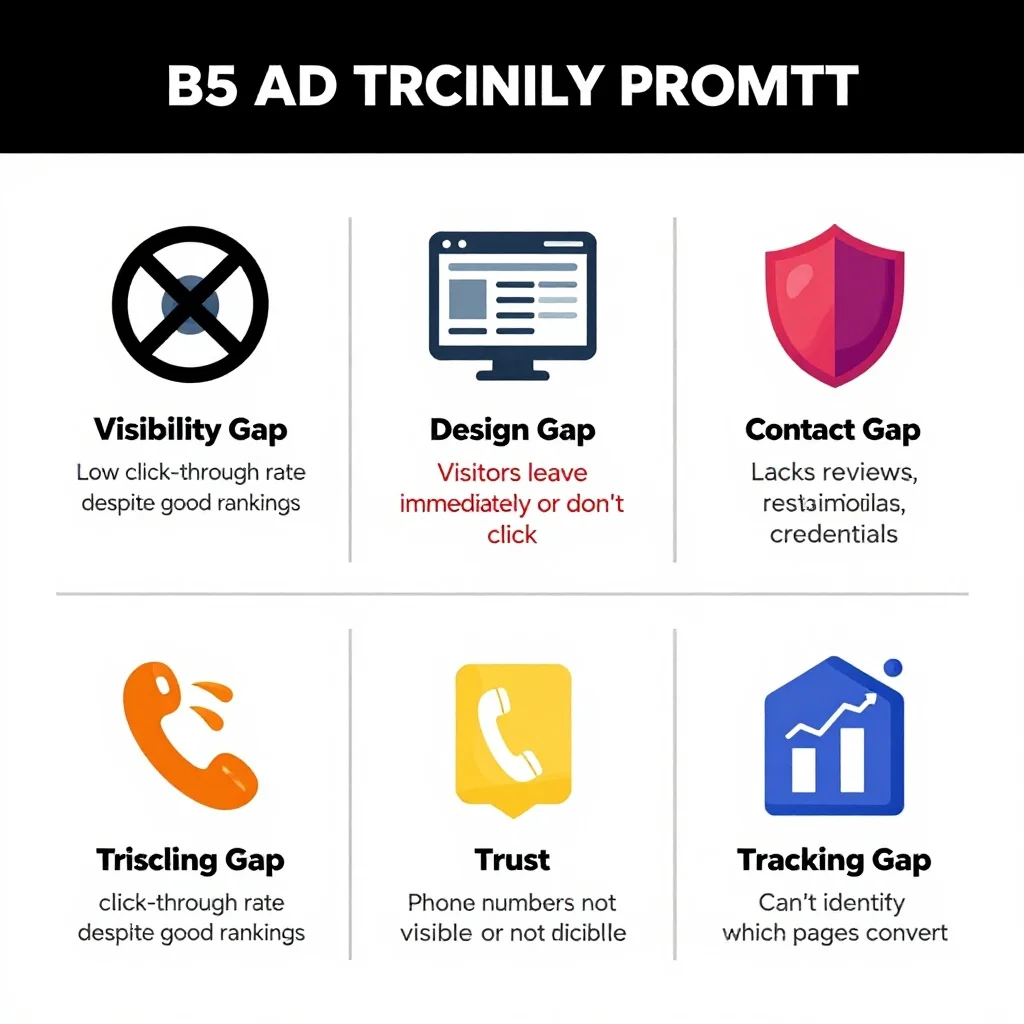
The Conversion Diagnostic: Why You Rank but Get No Calls
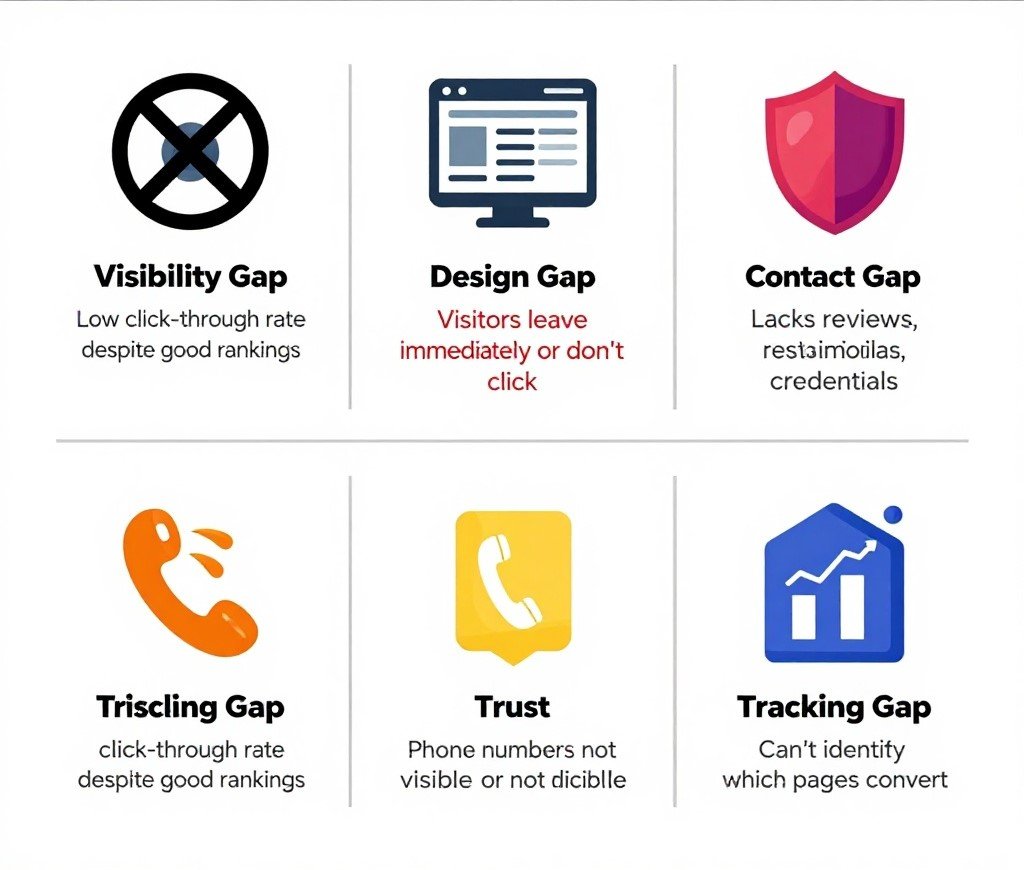
When a practice is ranking well but not generating calls, the breakdown is happening in one of five places.
Visibility gap : Check Google Search Console. Are you actually receiving clicks from your positions in the Search Engine Results Pages (SERPs)? If you rank in the top five but have a low click-through rate, your title tag and meta description are not compelling enough to earn the click — your ranking position alone is not doing the work.
Website design gap : Use session recording software like Hotjar or Microsoft Clarity. Watch how real visitors interact with your site. Do they leave immediately? Are they scrolling but not clicking? Is critical information buried below the fold? A visitor who cannot figure out what to do within 10 seconds will leave.
Contact method gap : Are phone numbers visible above the fold? Are they clickable on mobile? Is your booking button obvious? Some sites bury contact information on a separate page, requiring patients to hunt for basic access. That friction costs you calls.
Trust gap : New patients do not know you. Before calling, they need evidence that other real patients have trusted you and had good outcomes. Without testimonials, before-and-after results, and visible credentials, conversion rate suffers significantly.
Tracking gap : Are you tracking which pages generate actual calls or form submissions? Without this data, you are making changes based on assumption rather than evidence. Install call tracking and connect your site to Google Analytics 4 before drawing any conclusions.
Quick CRO Wins: Test These First
A/B test these high-impact elements before making larger investments:
- Button color : High-contrast blue or green typically outperforms neutral colors
- Button text : “Book Now” versus “Schedule Consultation” versus “Call Today” small wording changes produce measurable differences
- Form fields : Reduce from 10 fields to 5. Simpler forms convert at significantly higher rates
- CTA placement : Sticky header, hero section, and footer minimum
- Phone number visibility : Make it a button, put it in your header, make it impossible to miss
- Page load speed : Target under three seconds on mobile
- Mobile responsiveness : Test on actual phones, not browser previews
Each of these, if addressed, can improve appointment bookings by 10 to 20% without any change to your rankings. Save this as your dental SEO checklist for conversion work through the list systematically before moving to more complex optimizations.
Building Trust Signals on Your Website
Social proof converts more effectively than any promise you make about your own practice. For a dental practice’s online presence, trust signals are especially critical because you are asking patients to make healthcare decisions based on a website. Here is what actually moves the needle:
Patient testimonials : Video testimonials produce the strongest conversion lift because they show a real person, voice, and emotion. Written testimonials work well when they are specific and include the patient’s first name and photo. “Great dentist!” helps no one. “Dr. Smith completely changed how I feel about going to the dentist I used to cancel appointments. Now I actually look forward to them” is a trust signal.
Before and after galleries : With written patient consent, photographic results documentation is among the most powerful proof elements available for cosmetic and restorative services.
Staff bios with credentials : Include names, photos, degrees, specializations, and years of experience. SEO for healthcare professionals specifically depends on visible expertise signals — Google’s quality raters look for these directly, and patients use them to assess whether they are in capable hands.
Years in practice and awards : “Established 2008” and “Top Dentist Award 2024” provide third-party validation that adds credibility to your claims.
Insurance accepted : List specific insurers by name. Patients often filter on this before considering anything else. “We accept Delta Dental, Aetna, United Healthcare, Cigna, and most major PPO plans” is more persuasive than “we accept most insurance.”
Emergency availability : “Same-day emergency appointments available” reduces the friction that drives high-urgency patients to whichever practice is most obviously available.
Future-Proofing Your Dental SEO: Algorithm Updates and E-E-A-T
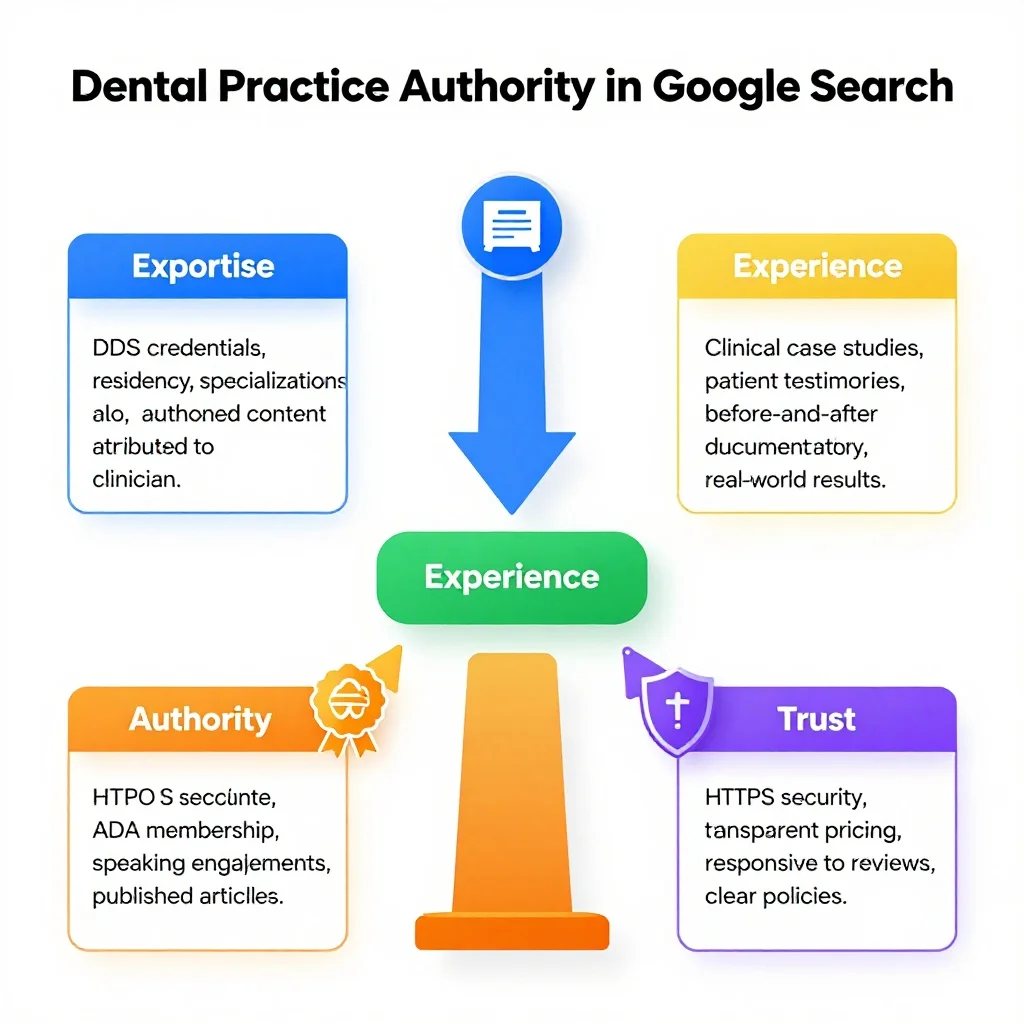
Google Algorithm updates over the past several years have consistently moved in one direction: toward quality, authenticity, and demonstrable expertise. The 2025 and 2026 updates reinforced three principles that dental practices especially need to understand: keyword stuffing detection, E-E-A-T requirements for health-related content, and the growing impact of AI-generated search summaries on organic click behavior.
How Google Detects Keyword Stuffing (And Why It Matters for Your Listings and Website)
Google’s current algorithm detects keyword stuffing in multiple places — not just GMB business names, but also website page titles, header tags, image alt text, and body content.
The principles are the same across all channels. A page that mentions “dental implants Austin” two or three times in genuinely relevant context will outperform a page that forces the phrase in ten times across unnatural sentences. A business profile name that reflects your actual brand will outperform one padded with services and locations.
Write for patients first. Use keywords where they genuinely belong and add clarity, not where they add density for its own sake.
E-E-A-T for Dental Practices: Expertise, Experience, Authority, Trust
Google treats dentistry as a YMYL topic “Your Money or Your Life” meaning dental content is held to the highest E-E-A-T standards of any content category. Building medical and dental authority on your website is not optional; it is a prerequisite for sustained rankings. SEO for healthcare professionals is evaluated under this framework specifically, and practices that ignore it consistently lose ground to competitors who take it seriously.
Here is what each E-E-A-T pillar means in practice for dental SEO best practices:
Expertise : Every piece of content on your site should have an identified author with visible credentials. A bio page listing your DDS, residency, specializations, and years of experience is not just nice to have — Google’s quality raters look for it explicitly. Your blog posts and service pages should be attributed to a named clinician, not published anonymously.
Experience : Patient case studies, before-and-after documentation, and testimonials describing specific procedures and outcomes demonstrate real-world clinical experience. Generic praise does not move the needle; specificity does. “Painless extraction” is forgettable. “I was terrified of having my wisdom teeth removed and Dr. Smith made it completely manageable” is a trust signal.
Authority : Board certifications, association memberships (ADA, AAP, AACD), published articles in dental journals, and speaking engagements signal that your practice is recognized by the broader profession, not just its own patients. Even local community involvement and press coverage contribute to authority signals.
Trust : HTTPS security, transparent pricing pages, clearly stated cancellation and refund policies, and consistent responsiveness to reviews are the trust foundations Google’s algorithm and human quality raters evaluate. A practice that hides pricing and is unresponsive to negative reviews signals untrustworthiness even when the clinical quality is excellent.
AI Overview Impact on Dental SEO
Google’s AI Overviews now appear at the top of search results for a wide range of dental queries, directly affecting dental practice online visibility in ways that require a strategic adjustment. These AI-generated summaries pull content from multiple sources to answer user questions directly on the results page — which means some users form an impression of your practice before ever visiting your website.
This does not eliminate the value of ranking, but it shifts the strategic priority. Content that earns placement in AI Overviews tends to share common characteristics: structured answers to specific questions, clearly attributed expertise, FAQ sections with direct concise responses, and short explanatory paragraphs rather than dense, meandering text.
For dental practices, FAQ sections on service pages are your best opportunity to appear in AI-generated summaries. Write each FAQ answer as a complete, standalone response of 40 to 60 words. Attribute answers to a named clinician wherever possible. These structural choices improve both AI Overview eligibility and featured snippet capture and they make your content more useful to patients regardless of where they encounter it.
The 90-Day Dental SEO Action Plan: What to Do First, Second, and Third
Everything covered in this guide is powerful but attempting it all simultaneously leads to paralysis and scattered results. The 90-day dentist SEO strategy below sequences the highest-impact activities in order of fastest payoff, so your first month of effort produces visible results before you have touched content or link building.
Weeks 1 to 2: GMB Optimization (Quick Win #1)
Complete your Google Business Profile using the seven-step framework above. Claim and verify your listing. Fill out every field completely. Add all services with descriptions. Upload 8 to 10 geo-tagged photos.
- Expected result: Improved local pack visibility within two to four weeks
- Time investment: Two to three hours
- ROI: High GMB optimization is the lowest-cost, fastest-payoff activity for dental practice growth at any stage, and it costs nothing beyond your time
Weeks 2 to 4: Review Generation System (Quick Win #2)
Train your team on the direct-ask method brief, personal, and timed to the end of positive appointments. Set up automated email and SMS follow-up requests with a direct link to your Google review page. Make sure every team member knows the script and uses it consistently.
- Expected result: 20 to 30 new authentic reviews per month
- Time investment: Five to ten hours to set up, two hours per week ongoing
- ROI: Highest possible reviews move the ranking needle faster than any other factor
Weeks 4 to 8: Website Technical Foundation
Fix the critical on-page issues that are costing you conversions from traffic you already have:
- Clickable phone numbers on every page
- High-contrast CTA buttons above the fold
- Mobile responsiveness tested on actual devices
- Page load speed under three seconds on mobile
Use Google PageSpeed Insights to identify specific speed problems. Fix them in order of severity. These changes improve how well your existing ranking positions translate into patient calls.
- Expected result: Improved conversion rate from current traffic
- Time investment: Five to ten hours
- ROI: High you are extracting more value from traffic you already paid for
Weeks 8 to 12: Content and Service Pages
Create five to eight core service pages using the high-converting blueprint: Dental Implants, Root Canals, Orthodontics, Emergency Services, Teeth Whitening. Each page should include a compelling headline, service explanation in patient-friendly language, why-choose-us points, the process in clear steps, before-and-after results, testimonials, an FAQ section, and a strong CTA.
This content creation phase is where dental practice digital marketing takes full shape — each service page you publish becomes a long-term asset that generates inquiries month after month.
- Expected result: Ranking for service keywords within two to three months
- Time investment: Ten to 15 hours writing plus design
- ROI: Medium-high builds on GMB and technical foundation
Month 4 and Beyond: Blog Content and Link Building
Publish one to two blog posts monthly using the 80/20 hyperlocal framework. Begin building citations across authoritative directories. Start the link building process using the TAR framework.
These activities have a longer payoff window three to six months but dental practice organic traffic compounds differently than paid traffic: each ranking you earn keeps paying dividends without an ongoing ad spend. By month six, the compounding effect of GMB, reviews, service pages, and links working together produces patient growth that becomes difficult for competitors to replicate quickly.
Measuring Progress: Key Metrics to Track
Track these metrics weekly or monthly depending on the pace of your implementation:
GMB metrics : Impressions, direction requests, and calls (visible in your Google Business Profile dashboard). These are your most direct indicators of local pack performance.
Review count and rating : Are you adding reviews consistently? Is your rating holding steady or improving? A drop in rating needs to be addressed faster than a drop in review velocity.
Website traffic : Google Analytics 4: total sessions, new users, and pageviews by landing page. Which pages are driving traffic? Which are not?
Dental practice search rankings : Monitor your top 10 to 15 target keywords weekly using a dedicated rank tracker. Which positions are rising? Which have plateaued? Which dropped after a competitor added new content?
Conversion rate : Phone calls or form submissions per session. This is the number that tells you whether your SEO investment is generating patients, not just traffic.
Cost per acquisition : If you are running ads alongside organic SEO, compare your cost per new patient across channels. Use this to allocate budget toward what is working.
Metrics without action are just noise. When a number is not moving in the right direction, it is pointing you toward a specific problem review velocity is slowing, a page has high traffic but poor conversion, or keyword rankings stalled after a competitor added new content. Each metric is a question that needs a diagnostic answer.
Should You DIY or Hire an SEO Agency? An Honest Comparison
The question I hear most from practice owners is: “Can I do this myself, or do I need to hire someone?” The honest answer depends on which tasks you are asking about. Some are genuinely DIY-appropriate. Others benefit significantly from professional expertise and tools.
What You Can DIY (And Should Start With)
These tasks do not require special training or expensive tools. You can learn them from guides like this one and implement them effectively with time and consistency:
- GMB optimization
- Review generation system setup and ongoing management
- Technical fixes clickable phone numbers, CTA buttons, basic mobile improvements
- Basic on-page title and meta description optimization
- Blog writing using the hyperlocal 80/20 framework
Time commitment: five to ten hours per week. Cost: free to $500 per month for tools.
What Justifies Hiring Help
Some tasks have a high expertise barrier that makes professional help genuinely worth the cost:
Keyword research methodology : Understanding how to identify the right dental keywords to target using difficulty scores, search intent matching, and topical clustering requires specialized tools like Ahrefs or SEMrush and significant analytical experience. Getting this wrong sets your content strategy in the wrong direction for months.
Technical SEO audits : Identifying site structure problems, crawlability issues, and Core Web Vitals failures often requires professional tools and pattern recognition that comes from auditing many sites.
Link building strategy : Finding and building relationships with quality, relevant linking sites is time-intensive and requires outreach expertise that most practice owners do not have.
Advanced content strategy : Building a strategic content calendar that addresses topical authority, keyword clustering, and content gaps requires competitive intelligence work that benefits from expertise.
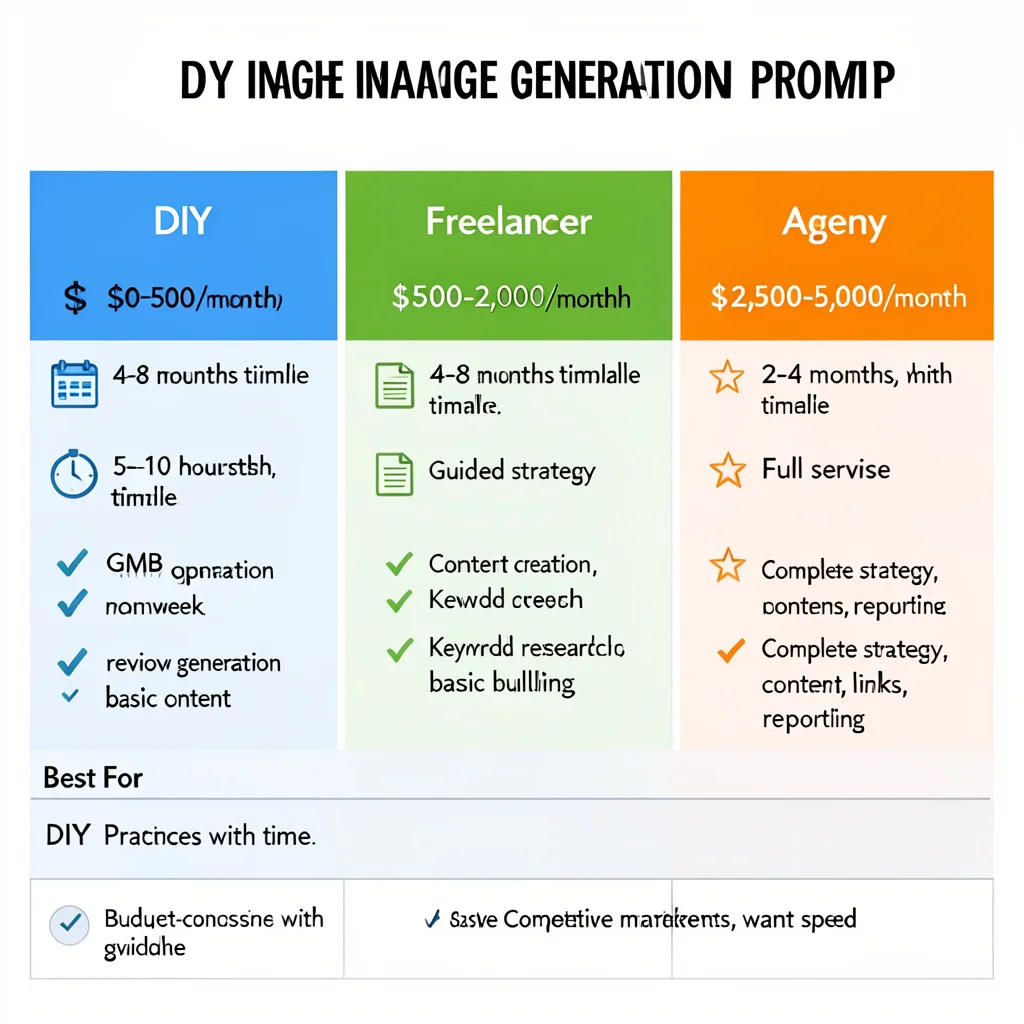
A good SEO professional saves you one to two years’ worth of trial and error but costs $2,500 to $5,000 or more per month depending on your market and competitive intensity.
Realistic Time and Cost Comparison
| Path | Monthly Cost | Expected Timeline | Best For |
|---|---|---|---|
| DIY | $0 to $500 (tools) | 4 to 8 months | Practices with time and willingness to learn |
| Freelancer | $500 to $2,000 | 4 to 8 months | Practices wanting guidance with budget constraints |
| Agency | $2,500 to $5,000+ | 2 to 4 months | Competitive markets where speed matters |
The most effective approach for most practices: DIY the GMB optimization and review generation (your highest-ROI quick wins), and hire for content strategy and link building once you are ready to scale.
Frequently Asked Questions About Dental Practice SEO
How Long Until I See Results from SEO for Dental Practices?
GMB changes typically show visibility improvements in two to four weeks. Review generation produces measurable ranking impact in four to six weeks as your count increases. Service page content typically takes two to three months to rank competitively. Full impact where you see a meaningful, sustained increase in new patient calls usually materializes within six to 12 months of consistent execution.
The key is that most practices see some improvement higher local pack impressions, more direction requests, the first new calls attributable to SEO within the first 60 days if they execute GMB and review generation properly.
What If I Am in a Highly Competitive Market?
Dental practice competitiveness varies dramatically by city and neighborhood, but even the most saturated markets have underserved service niches and geographic micro-areas where ranking is genuinely achievable.
Focus on search volume and intent matching for specific services rather than broad terms a term like “same-day dental implants Austin” often has lower competition and higher conversion intent than “dentist Austin.” Target specific neighborhoods instead of the entire metro. Build review velocity faster than your competitors. Create 10 pages of in-depth service content where competitors have three. Link quality over quantity. Competitive markets have more patients searching you just need to be smarter about positioning.
How Much Does Dental SEO Cost?
DIY: $0 to $500 per month in tools. Freelancer: $500 to $2,000 per month. Agency: $2,000 to $5,000 or more per month.
What matters is ROI. If a new patient appointment is worth an average of $500 to your practice and SEO generates 10 new patients per month, that is $5,000 in monthly revenue from a $2,000 investment a 2.5x return. Evaluate the channel on return, not cost.
Should I Use Google Ads While Building Organic Rankings?
Absolutely. Ads provide immediate dental office Google ranking visibility results typically appear within two to four weeks of launching a campaign. Improving your organic rankings takes three to six months. Many practices run both simultaneously: ads provide short-term patient flow while organic builds long-term, lower-cost acquisition.
Use ads to test which headlines, offers, and calls-to-action get the best response then apply those learnings to your organic service pages.
What Is the Most Important Ranking Factor for Local Dental Searches?
For the local pack: patient review signals. Volume, recency, and rating consistency are the dominant factors more important than backlinks, website content, or technical SEO. A practice with 500 high-quality reviews consistently outranks competitors with better websites and stronger backlink profiles. If you can only focus on one thing in your first 30 days, make it review generation.
Does Social Media Help with Dental Rankings?
Social signals do not directly impact search rankings, but social media engagement creates downstream effects: it can generate backlinks when content gets shared, builds brand recognition that improves direct search volume, and drives word-of-mouth referrals that show up as new patient calls. Think of social media as a supporting channel that amplifies your core SEO work, not as a primary ranking lever.
What If My Competitor Outranks Me Despite Being Less Qualified?
They likely have more or better reviews, stronger backlink profiles, better GMB optimization, or a higher-converting website or all four. Use Ahrefs or SEMrush to run a competitive audit and identify exactly what they are doing. Dental SEO implementation is ultimately a process problem, not a credentials problem. The practice willing to be systematic and consistent will outrank the more qualified one every time.
Can I Rank Without a Physical Office Location?
It is very difficult. Local SEO requires a real, verified address. Virtual practices face significant ranking challenges because Google’s local algorithm is designed around physical proximity. If you have multiple office locations, that is a genuine advantage you can create separate Google Business Profile listings and location-specific pages for each, compounding your local presence across multiple service areas.
Start Today: Your Next Step
Effective SEO for dental practices is not magic, and it does not require a massive agency budget or insider connections. It requires a clear priority order and the willingness to execute it more consistently than your competitors.
Your 90-day path in one sentence: optimize your GMB, generate authentic reviews, fix your website’s conversion fundamentals, then build service pages.
Start today with two hours on your Google Business Profile. That single afternoon of work will produce visible results within weeks and it sets the foundation everything else builds on.
Dental practice marketing at its core is about being findable when patients need you most. The practices that commit to this approach that treat reviews as their primary ranking lever, that keep their GMB current, that give patients a website that makes booking effortless those practices see meaningful, measurable patient growth within three to six months. Not because they found a shortcut. Because they showed up and did the work.
Your future patients are searching for you right now on Google. Make sure they find you first.