How to Fix “Error Establishing a Database Connection” in WordPress

What Does “Error Establishing a Database Connection” Mean?
This is one of the mistakes that I have observed at least dozens of times during the years. The initial occasion when I heard it, I panicked. My whole web site was blank with a single sickening page of text that said: “Error establishing a database connection.”
When your WordPress site reports that there has been an error connecting to a database just now, breathe deeply. This is one of the most popular WordPress problems and the error that creates a database connection in WordPress is nearly always easy to fix when you do the correct steps.
Understanding the Error in Plain Language
Consider your WordPress site as a house. What you can see in your server are the visible structure walls, roof, everything you see. Underneath the foundation is the database. And that foundation has just broken now. In WordPress, your database is the basis of that foundation.
Everything is important in your database. All of your blog posts. All of your pages. Your theme settings. Your plugin configurations. User accounts. Comments. Everything.
All this information is stored and accessed by a MySQL database server which is used by WordPress. Whenever a person accesses your site, WordPress links to this database, fetches the content and renders your pages.
This is what the error is all about now.
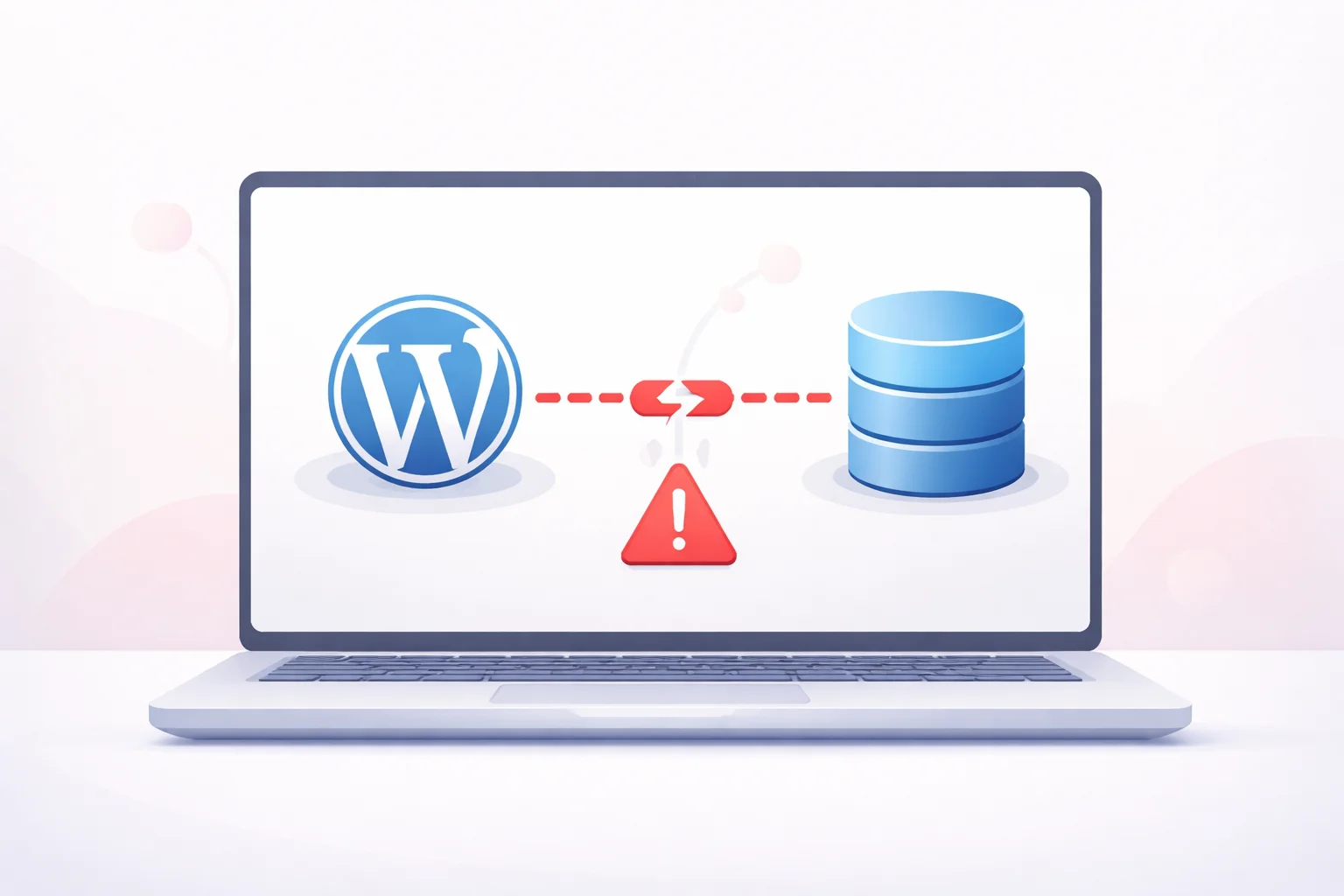
When you get the error establishing a database connection in WordPress, all it means is that WordPress attempted to connect to your database but was unsuccessful. The linkage between your database base and the files in your web site is not in place.
In its absence, WordPress will not be able to access any content. It is not able to display your home page. It is not able to load your posts. It is not even able to allow you to access your dashboard.
What You See When This Error Happens
The error of wordpress database connection comes in two locations.
On your frontend web site, visitors are met with an ugly plain white or grey screen with the text “Error establishing a database connection.” Nothing else loads. No header. No menu. No content. Only that one piece of writing.
The same situation can be observed on your wp-admin dashboard. When you attempt to log in at yoursite.com/wp-admin, the same error occurs. The issue of the wp-admin not loading occurs due to the fact that the system of signing in also requires database access to authenticate your identity.
Delete this sentence. It was already pointed out.
Why WordPress Cannot Connect to Database
There are a number of things that may sever this connection. Perhaps your database login password has been altered. Perhaps the database server has failed. Perhaps there were files corrupted.
The good news is that wordpress cannot connect to database errors nearly always have a simple solution.
And before we enter into the fixes, there is one thing that I want you to know now.
It is probably safe to use your content. This error normally implies that WordPress is unable to access your database not that your database is deleted or destroyed. Most of the time, your posts, pages and settings are there waiting. All you have to do is to re-establish the connection.
What Causes This Database Connection Error in WordPress?
I would like you to know what leads to the error in trying to establish a database connection in WordPress before I leap into solutions. Being aware of the cause will enable you to choose the appropriate fix instantly.
Having corrected this mistake many more times than I can remember, I have seen that it is nearly always reduced to the same few causes. Things are seldom exotic. Having conducted the repairs on hundreds of these, I began to see the same few wrongdoers recurring and recurring. The list is not as long as you might have expected, that is actually good news, as it narrows down on where to look.
Wrong Database Credentials in wp-config.php
This is the first reason. I can see it better than all the other causes that are put together.
Database credentials are stored in a file called wp-config.php in your WordPress site. There are four important pieces of information that are contained in this file.
DB_NAME- your database name. Consider it the name of the filing cabinet that all your content is stored in.
DB_USER is the username which is authorized to enter that database. It is as if it were a key to the filing cabinet.
DB- password is the password of that user this is your database password. WordPress cannot open the doors to your content without the appropriate database password.
DB_HOST The database hosts name. This informs WordPress on the location of database server. Hosting providers tend to use localhost but may peruse a particular IP address or server name.
This cuts people the most when moving your WordPress site to a different host. You switch to a different host, all the data is moved but the old credentials are still in place in the wp-config.php, which points to a database that does not exist anymore. The same credential problem may arise when importing content in the external sources or combining the data of other platforms in your WordPress database.
Or your hosting company alters your database password due to security measures. Or you inadvertently make changes to the file and leave a typo.
The malfunction of the database connection will occur immediately as a result of the single wrong character in any of those four fields.
Corrupted WordPress Database Tables
There are several tables in your WordPress database. Your posts, pages, comments, settings and user information are stored in an organized structure in these tables.
Combine into a single sentence: When such tables are damaged, WordPress is unable to read its own data – and the connection error is displayed.
In simple terms, what is the meaning of corruption? Think about a spreadsheet in which there are garbled characters in some of the cells rather than actual data.
Corrupted database tables tend to occur following partial updates. Perhaps your server went offline as WordPress was storing something. Perhaps there was a plug-in that was attempting to write the information in the wrong format. Perhaps a wordpress db error on update happened as the update process was halted along the way.
The positive aspect is that WordPress comes with an inbuilt repair feature. That will be demonstrated in the solutions section.
Database Server Is Down or Overloaded
The mysql database server is not responding at all, but your database credentials are correct.
This is a significant difference. Live web server: your site files are stored in a web server. Your database is stored on a database server. These may be the identical physical machine or other ones according to your hosting arrangement.
In an event where the database server is offline, a web site on that server will not be able to access its database. It is typical in circumstances of shared hosting server where hundreds of websites are sharing the same resources.
This can also be brought about by huge traffic jams. The database connection limit is reached when the number of visitors to your site overwhelm the database connection limit. The server is unable to support additional parallel connections and therefore, the new requests do not succeed.
What makes you think this is the cause? In case you have the right credentials and yet you observe the error, then the server itself may be the problem. I will show you how to check this and what to tell your hosting support.
Plugin or Theme Conflict After an Update
WordPress plugin conflict situation has the potential to result in database connection errors.
This is the manner in which it occurs. The culprit in this case is the sneaky updates of the plugins. The new version attempts to alter your database tables, a bug occurs halfway through the process and leaves things in a broken state. I have witnessed this most often with the types of plugins that will be touching WooCommerce tables or adding a new type of post.
I have encountered the situation of wordpress database error after updating the plugins several times. The convenience of automatic updates is that they can sometimes be problematic when the update made by the plugins is not thoroughly tested.
The same can happen when updating the theme. When one of the themes attempts to change the database entries during activation and something goes wrong, you have the rest of your site go offline. That is why it is so important to select some reliable themes of reputable developers and ensure the stability of the site in the long run.
The problematic aspect is that you are unable to get into your dashboard and turn off the problematic plugin. But do not worry. I will demonstrate how to deactivate the plugins without having to gain access to the dashboard.
WordPress Core Files Got Corrupted
To connect to a database, WordPress requires some core files to form a database connection. They exist in the wp-admin and wp-includes folders.
Should these wordpress core files become damaged then WordPress will not even start the process of connecting with your database. It does not even get to that stage. Infected core files may also cause WordPress critical errors not necessarily limited by database connection problems. What is the way of corrupting core files? The most common cause is failed updates.
When your server goes down during a WordPress update, there is a possibility that some of its files are not fully loaded. WordPress may also not write files properly due to file permission issues. This cause is not as prevalent as credential problems or corrupted tables, but it occurs. It is normally fixed by replacing the core files with new ones.
PHP Memory Limit Exhausted
All WordPress processes need server memory. There is no exception to connect to the database.
Once your server reaches its php memory limit, WordPress will not be able to run the script that will connect to the database. The process is not allowed to go to the end.
This is the reason why it is typical on low-cost shared hosting packages. Such plans usually configure small memory allocation such as 32MB or 64MB.
A complicated WordPress site that has a lot of plugins could easily require more than that. The aggravating factor is that memory fatigue occasionally occurs at random. You have a very nice site that works well until you run out of memory, causing the database error to appear.
This is normally solved by increasing your PHP memory limit. I shall demonstrate to you three ways of doing it.
Which Fix Should You Try First? Quick Diagnosis Guide
Now that you know the causes, I would save you some time. Rather than guessing in fixing the error, use this simple diagnosis guide to troubleshoot wordpress database error, quickly.
I have categorized this in accordance with what precipitated the mistake. Honestly answer these questions and directly jump to the most probable solution. Did this error start right after you changed hosting providers? Your old database credentials are still in your configuration file.
Go to Fix 1 and edit your wp-config.php with your new hosting account. It is the simplest method of correcting wordpress database connection error in migrating cases.
Was this error found since you have updated a plug in or theme?
The most likely cause is a conflict of a plugin. Fix 5 is the initial fix because it will disable the plugins without access to the dashboard. Should that fail, then you can use Fix 7 to repair the possible corrupted core files.
Was this mistake random with no modification on your part? Your database server may have gone offline or your database tables may be corrupted.
Fix 3 To verify whether the server is functional or not. Then run Fix 2 to fix your database tables.
Do you use XAMPP (or WAMP) to work on localhost?
There are other causes of local development. Jump to the special localhost section below. The troubleshooting is typically to check whether your MySQL service is actually running and to verify your local database credentials.
Was this mistake made following your site experiencing uncharacteristic traffic?
Probably your server has reached its connection limit or its memory is full. Try Fix 6 to increase PHP memory. Otherwise, also ask your hosting company regarding the limit of database connections.
Don’t know or when it began?
Start with Fix 1. In most instances, the problem can be solved by checking database credentials. Then go through the other fixes sequentially. Have this guide at hand. Also, you can review your wordpress error log to see certain hints as to what went wrong. In the majority of hosting panels, there is a section where you can see recent error logs.
7 Ways to Fix Error Establishing a Database Connection in WordPress
Now I will demonstrate how you can step by step fix error establishing a database connection in WordPress.
I have ordered these solutions in the order of ease to the most advanced. The majority of individuals address the issue using the initial two fixes.
However, I would like you to have all the options that are possible so as to have a more complex situation. You can be taught how to resolve database connection error in wordpress without having to learn how to code.
All the techniques that I will present below involve easy steps that can be followed by anyone. The above diagnosis guide allows you to navigate to the most appropriate fix.
Or begin with Fix 1 and go through them sequentially.
Fix 1: Check Database Credentials in wp-config.php
This fix is more effective in fixing database connection errors than all other fixes.
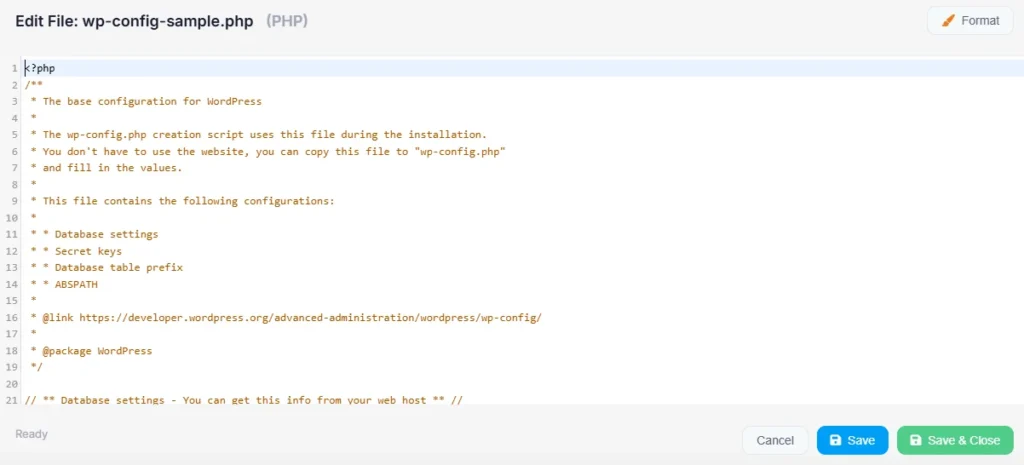
Here I always begin. You should confirm that the database credentials contained in your wp-config.php file are reflective of your real database credentials.
A single misplaced character will result in a broken connection. The fastest way in is your hosting File Manager. No FTP client was required with this one.
Step 1: Open your hosting File Manager
Access your hosting control panel. Search in files section File manager.
Click to open it. When you want to use FTP, make a connection with your server with the help of the FTP client such as FileZilla.
Go to the root of your web site. Placeholder screenshot: cPanel dashboard with the File Manager highlighted.
Step 2: Navigate to your WordPress root folder
Click on public in the public_html or www folder. This is the place your WordPress files are located.
There are folders such as wp-admin, wp-content, and wp-includes.
Step 3: Find and edit wp-config.php
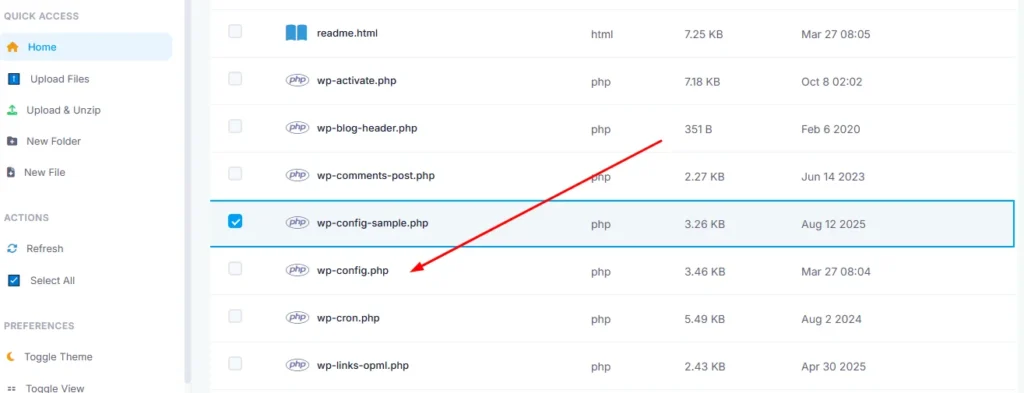
Find the file that is called wp-config.php. Right click on it and choose either Edit or Code Edit. Placeholder of a screenshot:
File Manager with location of wp-config.php highlighted.
Step 4: Locate the database settings
Keep on scrolling down until you come across lines that begin with define. These are configuration constants of db which informs WordPress how it can connect to your database.
Find the following four entries:
textdefine( 'DB_NAME', 'your_database_name' );
define( 'DB_USER', 'your_database_user' );
define( 'DB_PASSWORD', 'your_database_password' );
define( 'DB_HOST', 'localhost' );
Write down or copy these values. You must check them all.
Screenshot landing: wp-config.php open in the editor with the section of database credentials.
Step 5: Check your actual database information
Return to your cpanel database.
Find MySQL Databases. Here you are able to view your real database name and users who are assigned to this database. Compare each of these values to that which you observed in wp-config.php.
Screenshot dummy: MySQL Databases area with database list.
Step 6: Fix any mismatches
When the name of the database is not the same, change it in wp-config.php.
In case the username is not the same, update it in the wp-config.php. To change the password of the database, you have to change it at cPanel and then change the same database password at once in wp-config.php during the same session.
Always make sure to do both before closing File Manager. localhost is the typical database hostname. But there are hosting providers that make use of a certain server address.
See your documentation on hosting, in case localhost fails.
Step 7: Save and test
Save the file of the wp-config.php. Go to your website and refresh the page.
In the event that it was the credentials that were the issue, your site should be loaded at this point.
Fix 2: Repair Your WordPress Database
When you are certain about your credentials but still notice the error, then you may have corrupted database tables. WordPress has an inbuilt repair tool. Allow me to demonstrate to you how to fix wordpress database without access to phpmyadmin.
Step 1: Open wp-config.php again
With File Manager, you can access and edit your wp-config.php file in the same way as in Fix 1
Step 2: Add the repair code
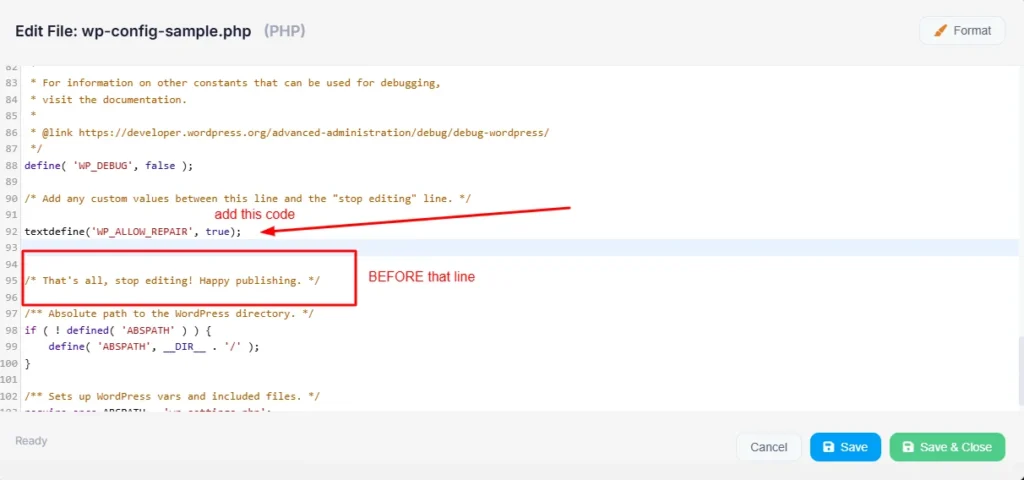
Find the line that says:
text/* That's all, stop editing! Happy publishing. */Right BEFORE that line, add this code:
define('WP_ALLOW_REPAIR', true);Make sure you add it above the “stop editing” comment, not below it.
Screenshot placeholder: wp-config.php showing where to add the repair code
Step 3: Save the file
Save your changes to wp-config.php.
Step 4: Visit the repair page
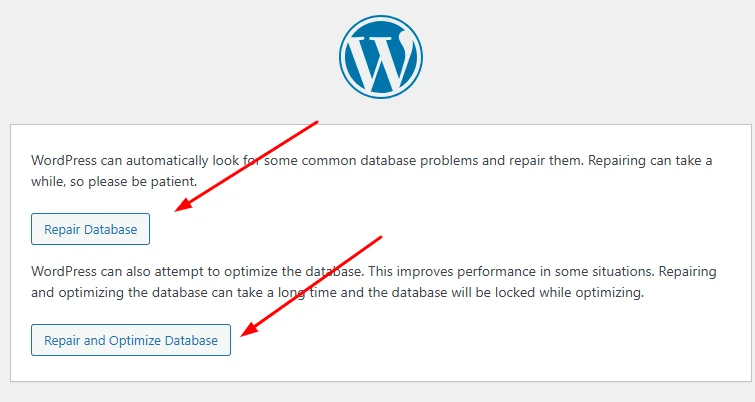
Open your browser and go to:
textyoursite.com/wp-admin/maint/repair.phpReplace yoursite.com with your actual domain name.
You should see a page with two options: Repair Database and Repair and Optimize Database.
Step 5: Run the repair
Click Repair and Optimize Database.
The option will repair damaged database tables and optimize them to achieve a high level of performance. Allow the process to take place.
A report will be presented indicating which tables were repaired.
Screenshot filler: WordPress database repair screen
Step 6: Remove the repair code immediately
This step is critical for security. Go back to wp-config.php and delete the line you added:
textdefine('WP_ALLOW_REPAIR', true);If you leave this code in place, anyone can access your repair page without logging in. Always remove it after repairing.
Step 7: Test your website
Refresh your website. If corrupted tables were the problem, your site should work now.
Fix 3: Check If Your Database Server Is Running
If you’ve confirmed the credentials and run the repair tool and you’re still staring at that error screen the database server itself may have given up. This is out of your hands, but it’s easy to confirm.
Here is how to check.
Step 1: Try accessing phpMyAdmin
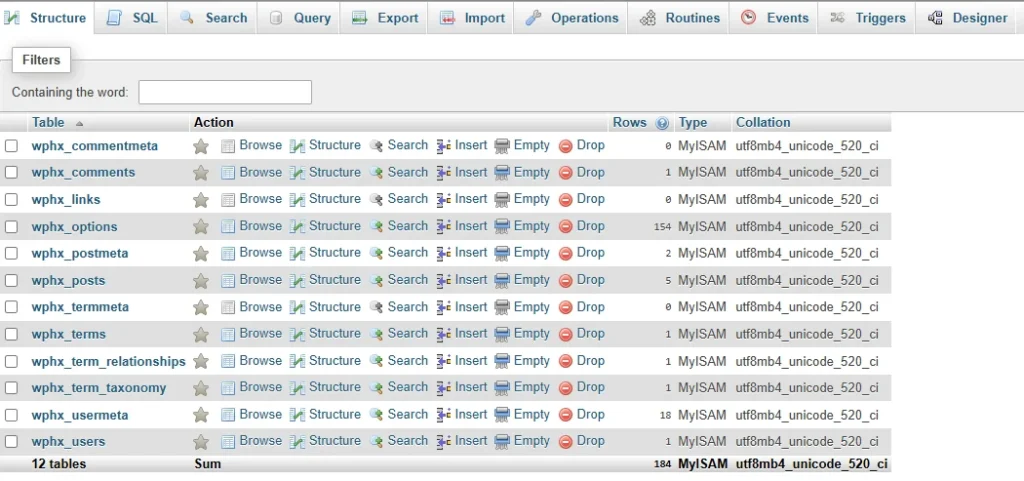
Log into your hosting control panel. Look for phpMyAdmin and click to open it.
Step 2: Observe what happens
When phpMyAdmin loads, and you can see your database tables, the server is fine.
Your trouble lies elsewhere. When the phpMyAdmin displays an error or does not load, then the database server is not online.
It is a hosting problem which cannot be resolved by you ownself
Step 3: Check other sites on the same hosting
If you have multiple WordPress sites on the same hosting account, check if they all show the same error. If yes, this confirms the server is down.
Is it advisable to call hosting support?
Yes provided the server itself is offline and that you have already ensured that your authentication credentials are valid.
The following is the verbatim message that you can copy and paste to support: My WordPress site at dailyblogguide.com is giving the message of showing an error of establishing a database connection.
I have confirmed that my credential associated with my wp-config.php is correct. Please can you please check whether the MySQL server is running and whether my database user has the right permissions or not?
This message reflects the support that you did some elementary troubleshooting. They will have the more of your request, and will rise quicker
Fix 4: Restart MySQL Database Server
In some cases the MySQL
server is alive but is in a problematic state. Rebooting it gets rid of the problem. For cPanel users: In your hosting panel, find MySQL Database server or Restart Services. Other hosts have this option as part of the Advanced section. Click restart, wait 30 seconds.
In case of Hostinger hPanel users:
Go to Data Bases folder. Find MySQL or database management solutions. There are panels that have a restart option.
In the majority of shared hosting:
It is unlikely that you can start MySQL by yourself. Contact hosting help and request them to turn on the MySQL service in your server.
Restarting, allow about 60 seconds then refresh your web page. The server must be given time to establish all connections back on line
Fix 5: Deactivate All Plugins via File Manager
When the error has just occurred, and you have just updated the plugins, there is a high probability that the error is caused by the plugins.
Here’s how to test it no dashboard needed.
Step 1: Access File Manager.
Logging in to your hosting control panel, open up File Manager.
Step 2: Go to folder wp-content.
Open public_html, then, you will see the folder of wp-content. S
tep 3: Rename the plugins folder
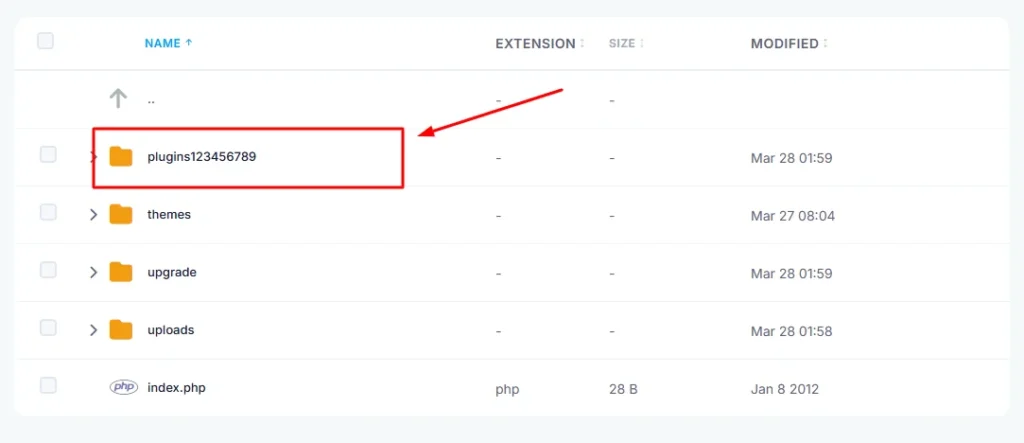
Locate a folder called plugins. Right click on it and select Rename.
Rename the name to plugins_disabled or plugins old.
Step 4: Test your website Refresh your website.
Provided that it loads now, there was a problem with a plugin.
Step 5: Find the problematic plugin Renamed the folder to the name of the plugins.
At this point open the plugins folder. On the inside, you will be able to see individual folders of each of the plug-ins.
Rename all the folder of the plug ins one at a time with the suffix disabled added to the name. After each rename, check your website. You identified the culprit when the site breaks again after renaming a certain folder of the plugins.
Step 6: Deal with the bad plugin Completely remove the problematic plugin folder.
Find another similar plugin which performs the same task. In finding the alternative of a discovered plug-in, doing so by concentrating on those that have been well maintained and whose records of support and compatibility are good.
The same can also be done with themes. Rename the themes_disabled the themes_themes. WordPress will revert to default theme. In case the site is operational, then it was your theme that was the issue.
Fix 6: Increase PHP Memory Limit
If your server runs out of php memory limit, WordPress cannot complete the database connection. Here are three methods to increase memory.
Method 1: Edit wp-config.php
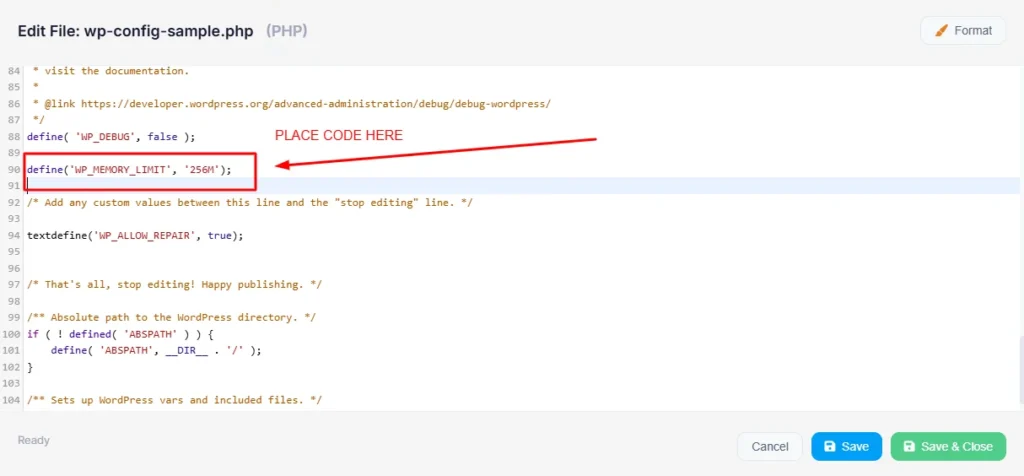
Open wp-config.php using File Manager. Add this line before the “stop editing” comment:
define('WP_MEMORY_LIMIT', '256M');Save the file and test your website.
Method 2: Edit .htaccess file
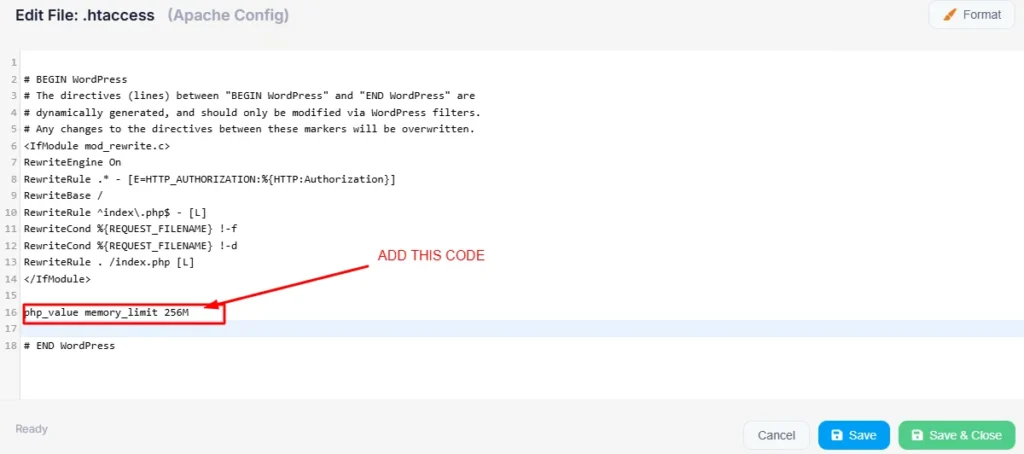
Open the htaccess file in your WordPress root folder. Add this line:
php_value memory_limit 256MSave and test. Note that this method only works on Apache servers, which is what most shared hosts use.
Method 3: Edit php.ini
Some hosts allow you to create or edit a php.ini file. Add this line:
memory_limit = 256MIf your host does not allow php.ini edits, contact support and ask them to increase your PHP memory limit.
Which method should you use? Start with Method 1 because it works on most setups. Try Method 2 if the first does not work. Use Method 3 or contact support as a last resort.
Fix 7: Replace Corrupted WordPress Core Files
This is a fix of the last resort. It is not to be tried unless nothing else succeeded.
When you have gone and corrupted your wordpress core files, then you will not be able to do anything with WordPress. The stubborn connection errors are usually addressed by replacing the old copies with new ones.
Step 1: The first step is to back up your whole site.
Always make a full copy of a core file before accessing it.
Download your wp-content folder and wp-config.php file to your computer. Export your database also in phpMyAdmin, assuming that this is possible.
This is not a step that can be afforded. In case of failure, you have to recover your site.
Step 2: Install new WordPress.
Visit wordpress.org/download and get the latest version of WordPress. Copy it to your computer.
Step 3: Unzip the files.
Unzip the file you have downloaded on your computer. You will find folders such as: wp-admin, wp-content, and wp-includes as well as separate files.
Step 4: uploading of wp-admin folder.
With File Manager or FTP, copy the wp-admin folder of the new download to your server. When prompted to, overwrite the existing folder.
Step 5: Upload wp-includes folder Copy the folder of wp-includes of the new download.
Overwrite an existing folder.
Step 6: Do NOT touch these things Do NOT post wp-content folder.
Your themes, plugins and uploaded media are found in this folder. Deleting it would delete your customizations. Do NOT posted wp-config.php. This is a file that holds your database credentials and site settings. You would like to retain your current file.
Step 7: Test your website Refresh your website.
In case of the corrupted core files issue, then your site must be loaded now
How to Fix This Error on Localhost XAMPP WAMP or Local
If you see the wordpress database connection error on localhost, the causes and solutions differ from live hosting. Let me walk you through the specific fixes for local development environments.
Check If MySQL Service Is Running
It is the most widespread localhost problem. Your MySQL service may not have been started.
For XAMPP users:
Take a glance at the WAMP icon in your system tray. Should it be orange and red, then services are not operating properly.
Click the icon with the left hand and access MySQL. Make sure the service is started
Verify Your Database Exists
You may sometimes forget to establish the database prior to installing WordPress. Open your browser and go to localhost/phpmyadmin. See the left sidebar.
That should be listed in your database. In case it is not there, you have to make it. Click New in phpMyAdmin. Enter a database name and click Create.
Develop a Database User and have Proper Privileges
Your database is there but WordPress is unable to connect with database since the user is not allowed. In phpMyAdmin, click on your database name.
Click on Privileges tab in the upper left. Click Add user account. Fill in a username and password. In the case of the host, choose localhost in the dropdown. Go down to Global privileges and select Check all. This allows the user to access the database completely.
Click Go and save the user.
Update Your Local wp-config.php
Open your WordPress installation folder on your computer. Edit the wp-config.php file with a text editor like Notepad.
Make sure the credentials match what you just created:
textdefine( 'DB_NAME', 'your_database_name' );
define( 'DB_USER', 'your_new_username' );
define( 'DB_PASSWORD', 'your_new_password' );
define( 'DB_HOST', 'localhost' );
Special note for XAMPP: The default MySQL user is root with a blank password. You can use these credentials if you have not changed them:
textdefine( 'DB_USER', 'root' );
define( 'DB_PASSWORD', '' );
Special note for WAMP: WAMP sometimes uses port 3307 instead of the default 3306. If localhost does not work, try:
textdefine( 'DB_HOST', 'localhost:3307' );Save the file and refresh your local WordPress site.
WordPress Database Error After Changing Hosting Do This
The wordpress database error after changing hosting is extremely common. I see this question almost daily.
Here is why it happens and exactly how to fix it.
Why This Error Happens After Migration
When you transfer your WordPress installation to a new host, the database will be created on the new server.
However, your wp-config.php file still has your previous hosting details. Moving WordPress to a different host? This credential relationship needs to be understood previously to avoid this mistake altogether.
Think about it. The database of your old host was called oldhost_wp123 and the user was oldhost_user. A new host builds a database with the user newhost_admin in the database named newhost_wp456.
Assuming that your wp-config.php is still set to oldhost_wp123, WordPress attempts to connect to a database (that does not exist on the new server). Error connecting to database wordpress is the result
Find Your New Database Credentials
Log in your new hosting control panel. Go to MySQL Databases or equivalent.
Find your database name. It typically has a prefix with your hosting username.
Get the database user which is allocated to that database. In case you are not aware about the password, then use the Change Password option to enter a new password.
Write down all four values: database name, username, password, and hostname
Special Note About Database Hostname
Here is something that trips up many people. The database hostname is not always localhost on every host.
Some hosting providers use a specific server address like:
textmysql.yourhost.comOr an IP address like:
text192.168.1.100Check your new hosting documentation or support resources for the correct database hostname. Using the wrong value causes the connection to fail even if everything else is correct.
Update wp-config.php with New Credentials
Access your wp-config.php file on the new server using File Manager.
Update all four database credentials to match your new hosting information:
textdefine( 'DB_NAME', 'newhost_database' );
define( 'DB_USER', 'newhost_user' );
define( 'DB_PASSWORD', 'yournewpassword' );
define( 'DB_HOST', 'localhost' );
Save the file and test your website.
Verify Your Database Was Migrated Correctly
In some cases the very migration does not succeed.
Your database might not have transferred completely to the new host. Access the phpMyadmin on your new host.
Click in your database name. Test to see whether you can see WordPress tables such as WordPress posts, WordPress options, and WordPress users.
When the tables are either non-existent or empty, then your database migration has failed. You need to import your database again from a backup or export from your old host
The Error Keeps Coming Back Here Is Why and How to Stop It
I fixed the error yesterday. Everything worked fine. The wordpress database error is now reoccurring. What is going on?
It is exasperating, I tell you. A persistent wordpress db connection error is typically a symptom of an underlying problem that cannot be solved by brushing the problem away temporarily through a temporary fix
Database Connection Limits on Shared Hosting
Each shared hosting server has a limit on the number of database connections.
This restricts the number of simultaneous connections that your database can support. Once you reach such a limit, new connection requests no longer succeed.
The error is manifested where nothing is actually broken. This usually occurs when there are traffic peaks. In the case of 50 visitors arriving at the same time your database may not be able to support all the concurrent requests.
The answer is to minimize the number of database connections or to upgrade your hosting. Caching plugins are useful, as they serve pages without having to access the database to do so
Memory Leaks from Poorly Coded Plugins
Certain plugins contain memory leakages. They keep on increasing server resources with time until the server becomes memory starved.
When memory runs out, database connections fail. You restart or fix the issue, but the leak continues. The mistake recurs in hours or days.
Determine resource intensive plugins with such tools as Query Monitor. Uninstall or delete those that are using too much memory.
MySQL Server Instability
In case your hosting company is having a shaky MySQL server, the errors will keep reoccurring.
You can not fix this. Watch for patterns. Is the mistake particular at certain times? During peak hours? These trends indicate problems with servers. Send your hosting support documentation of the time when errors happen.
In case the issue continues, then look into changing the host to one that is more trustworthy.
Database Tables Keep Getting Corrupted
When you have to repeat the process of repairing database tables, something is repeatedly corrupting the database tables.
Potential causes are incorrect code written by poorly coded plugins in the data writing process, crashing the server during the database operations, or disk errors on the hosting server.
Run the database repair. Then monitor closely. Should corruption happen once again in days or weeks, check plugins or think of switching to a new host with superior server hardware.
Long Term Solutions
Install uptime for monitoring to receive notifications when your site is offline. UptimeRobot provides a free monitoring.
Make sure that you optimize your database on a regular basis using database optimization tools such as the Wp-dbmanager.
Clean databases are not easily corruptible. Consider upgrading from shared hosting server to VPS or managed WordPress hosting. The following options offer special resources and a more solid database connection
How to Prevent Database Connection Errors in WordPress
I have received the midnight panic message of site owners who had no backups, no monitoring and no idea how long their site had been down. Do not be such a person.
These measures will save you hours and will take you 20 minutes to install. This is where you can stop database connection error in wordpress before it occurs
Keep Regular Automated Backups
Your most important protection is a recent backup. In case of a break, you can have your site up and running in no time.
Install UpdraftPlus or other backup plug-in. Automatically back-up at least once every week. Backup of the store to cloud storage, such as Google Drive or Dropbox, not to your hosting server.
Keep, this is one of the best lines in the article.
Protect Your wp-config.php File
One should never make any edits to the file of wp-config.php unless they are well informed of what they are actually doing. One wrong character can take down your site.
Prior to editing, save a copy on your computer. When what you are editing breaks, you can save the original. Check file permissions, too. Everybody should not have a writable wp-config.php.
Request your host to ask in the right permission settings. One of the factors in securing your WordPress installation is file permissions, but you need to understand more about the best practices of securing your WordPress installation to ensure that all your important files are securely stored in place
Keep WordPress Updated Carefully
Updates contain fixes of security holes and bugs.
However, haste in updates may lead to issues. Wait a few days after significant releases of WordPress before updating. Allow other people to find out problems.
When you can, test updates on a staging site before implementing it on your live site. Always update a number of things simultaneously.
Install the new WordPress core, and test. Install update parts one by one, and then test. By so doing you can discover precisely what aroused a difficulty.
Choose Reliable Hosting
Free hosting and very cheap hosting usually have erratic database servers.
They over-sell resources i.e. there are excessive sites that are linked to the same database server. Invest in quality hosting in case of serious websites.
Managed WordPress hosts such as Cloudways or good shared hosts with positive reviews are worth paying the extra price. The rate of your wordpress site down database error is reduced significantly due to the presence of reliable infrastructure
Set Up Uptime Monitoring
Be informed of issues prior to your visitors.
Free uptime monitoring systems will notify you when your site goes offline. UptimeRobot monitors your site every 5 minutes and is free.
Better Uptime has the same features with pretty reporting. Set up notifications to visit your mobile phone or email. The faster you know about an issue, the faster you can fix it
Use Caching to Reduce Database Load
Each page request in WordPress will typically involve several database queries.
Caching is the ability to use pre-created pages without having to access the database. Install LiteSpeed Cache as long as your host can support it.
Otherwise, both WP Fastest Cache and W3 Total Cache are good. Caching will minimize the load on the database. Reduced queries allow fewer opportunities to run into connection limits or waste resources
Free Tools to Monitor Your WordPress Database Health
Here are the tools I actually use for database monitoring.
UptimeRobot monitors your site every five minutes. When your site goes down for any reason including database errors, you get an alert immediately. The free plan covers 50 monitors.
Query Monitor is a plugin that shows you database queries on every page. You can identify slow queries, errors, and plugins that make too many database calls. Install it on development or staging sites for investigation.
WP-DBManager lets you schedule automatic database optimization and repair. A weekly optimization keeps your database clean and reduces corruption risk. You can also back up your database directly from the plugin.
WP-Crontrol shows you all scheduled tasks in WordPress. Sometimes a runaway cron job causes database problems. This plugin helps you identify and manage scheduled events.
Enable wordpress debug mode temporarily when investigating issues. Add this to wp-config.php:
textdefine('WP_DEBUG', true);
define('WP_DEBUG_LOG', true);
This writes errors to a wordpress error log file in your wp-content folder. Check this log for clues about what is failing.
Remember to turn off debug mode when you finish investigating.
Frequently Asked Questions
How to prevent database connection error in WordPress?
Automatically back up regularly with the help of such a plug as UpdraftPlus. Do not edit wp-config.php unless there is a reason to do so. Keep WordPress, themes and plugins updated with testing. Choose a trusted hosting with favourable reviews. Create free uptime monitoring systems such as UptimeRobot. Install caching plugs in order to make the database less loaded.
How to repair WordPress database without phpMyAdmin?
WordPress has an inbuilt repair option. To your wp-config.php file add the following line: define(WP_ALLOW_REPAIR, true); Next browse yoursite.com/wp-admin/maint/repair.php to your browser. Press the repair button. Also remember to delete that code line as soon as the repair is done due to security reasons.
How can I fix database connection error in WordPress without coding?
Any fixes in this guide are only possible with zero coding know-how. You make config changes by modifying simple text values. When one adds the repair code, all one needs is to copy and paste one line. Each action takes place in your hosting control panel where you can point and click at the actions. You can correct this mistake, should you be able to use email.
Is it advisable to call hosting about WordPress database error?
Contact hosting support in case you confirmed your credentials are correct but the error still remains. They should also be contacted in case phpMyAdmin does not load, and this is an indication that the database server is not active. Your hosting company can monitor server health, re-establish database permissions and re-start MySQL services. Give certain information concerning what you have already done.
How long does it take to fix WordPress database error?
The majority of cases can be solved in the range of five to fifteen minutes through the credential check method. Even basic reasons such as incorrect passwords or typing errors can be corrected in just minutes. More complicated problems such as corrupted table or server issues may require an hour. Depending on the size of the sites, replacing core files or moving databases may take longer.
Does this false alarm imply that my WordPress webpage is attacked?
Usually no. Database connection error is a technical problem, rather than security breach. It happens due to the mismatch of credentials, server issues, or file corruption. But in case you observe other suspicious changes in addition to this mistake, then enquire more. Always update WordPress, themes and plugins in order to ensure security.
Will a database connection error happen due to a plugin in WordPress?
Yes, it is possible that the error was caused by the plugins. A malfunctioning update to a plug-in may corrupt database tables or steal excessive server memory. Connection limits on shared hosting can also be caused by the excessive number of database queries generated by the plugins. When the error began to occur after a plugin update, deactivating the plugins in the File Manager will often lead to the guilty party.
Why would it be a mistake to connect to a database in WordPress?
The most common ones are incorrect database credentials, corrupted database tables, database server downtime, conflicts with other plugins, exhausted PHP memory or corrupted WordPress core files. The reason lies in what preceded the occurrence of the error. Credential mismatch is commonly caused by hosting migrations. Table or file corruption sometimes occurs when you update.
Will I lose my posts in case WordPress displays the database error?
In most cases, no. The information and posts that you post are stored in the database which normally does not get lost. The error indicates that WordPress is not able to connect to the database, not that database is deleted. After you re-establish the connection, your content should be in the same state as you had left it. Nevertheless, the regular backups should always be done to safeguard.
Why does WordPress give an error of establishing a database connection?
This error is displayed by WordPress when it is not able to communicate with your MySQL database. This is most likely to be caused by incorrect database credentials in your wp-config.php file. Other reasons are the corruption of the database tables, the overloaded database server, or the hosting server problems. The error implies that WordPress is not able to access your content to show your site.
Now your WordPress Site is back online.
Now you have seven sure ways of solving error establishing a database connection in WordPress. The fixes apply to 99 percent of all cases that I have dealt with. Start with checking your database credentials in wp-config.php.
This one-fix fixes most of the problems. Should that fail, then repair your database tables with the built in tool. Next, ensure that your database server is functioning well. In cases of intractable problems, disable plugins in File Manager, raise your PHP memory limit or replace damaged core files.
Every solution will address a particular cause. In case you have done all possible and the mistake does not stop, address your hosting support. You can use the exact message script that I have given you above. Provide them with information concerning what you have already tried. Well-trained support teams are able to search more into server logs and database permissions.